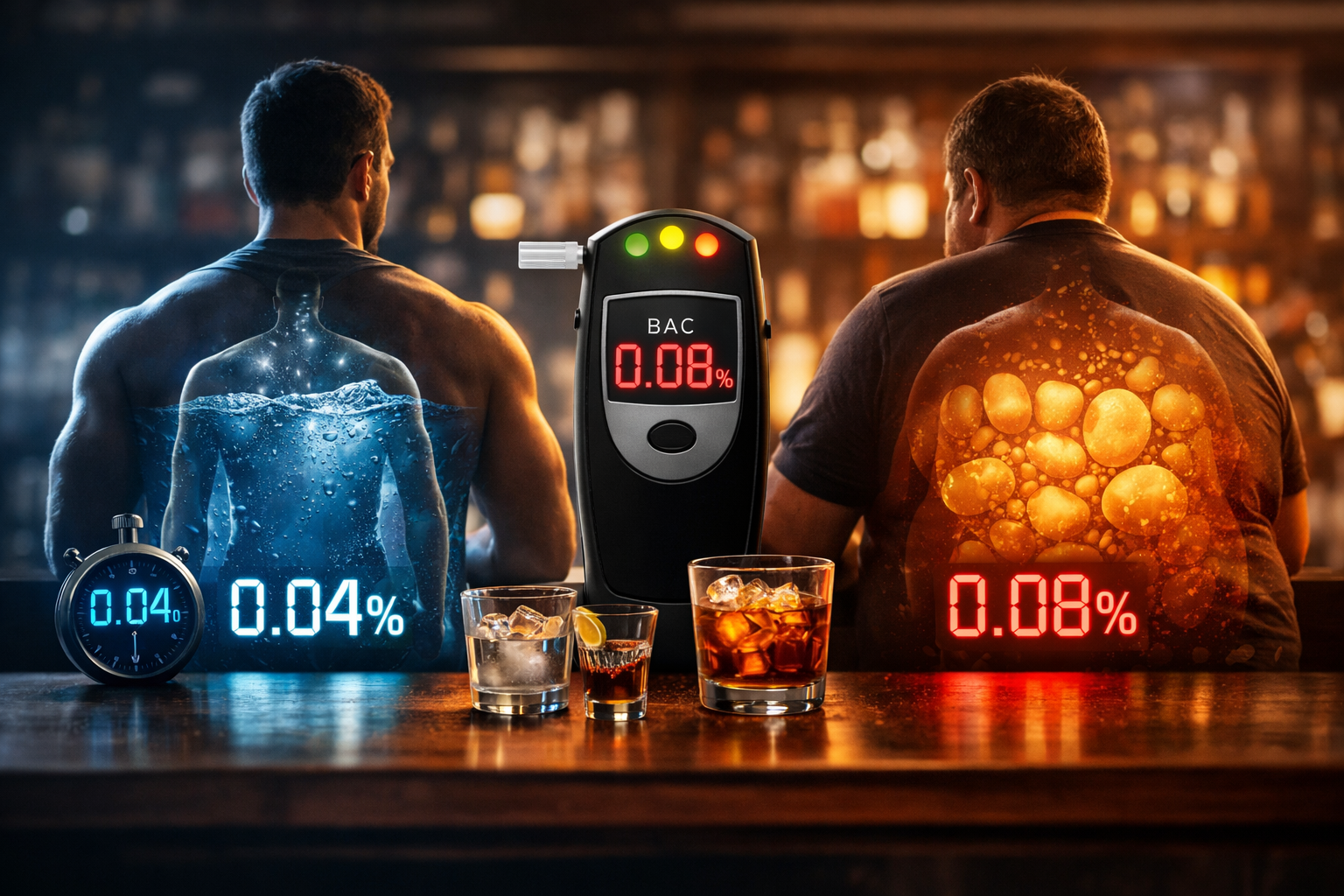
It started as one of those ordinary nights—the kind you barely remember the next morning. Three friends, same bar, same laughter, same weight on the scale, and nearly the same drinks lined up on the table.
By every chart and calculator, they should have been on the same track. But as the rounds went on, the illusion cracked. One friend stayed sharp, steady, almost untouched. The other began to stumble—not dramatically, but in those subtle ways you only notice when you’re watching closely – slower words, softer focus, a faint flush creeping across his face.
That moment—two people, same weight, same drinks, but wildly different reactions—was the spark. It was the night I realized that alcohol doesn’t play by the simple rules we’ve been taught.
And that realization sent me digging into the science—into body composition, metabolism, and the hidden variables that BAC charts never show. Here’s how I found out people weighing 180 lbs will reach $0.08 at different speeds.
The Problem With Most BAC Calculators
Most BAC calculators are built around simplified averages.
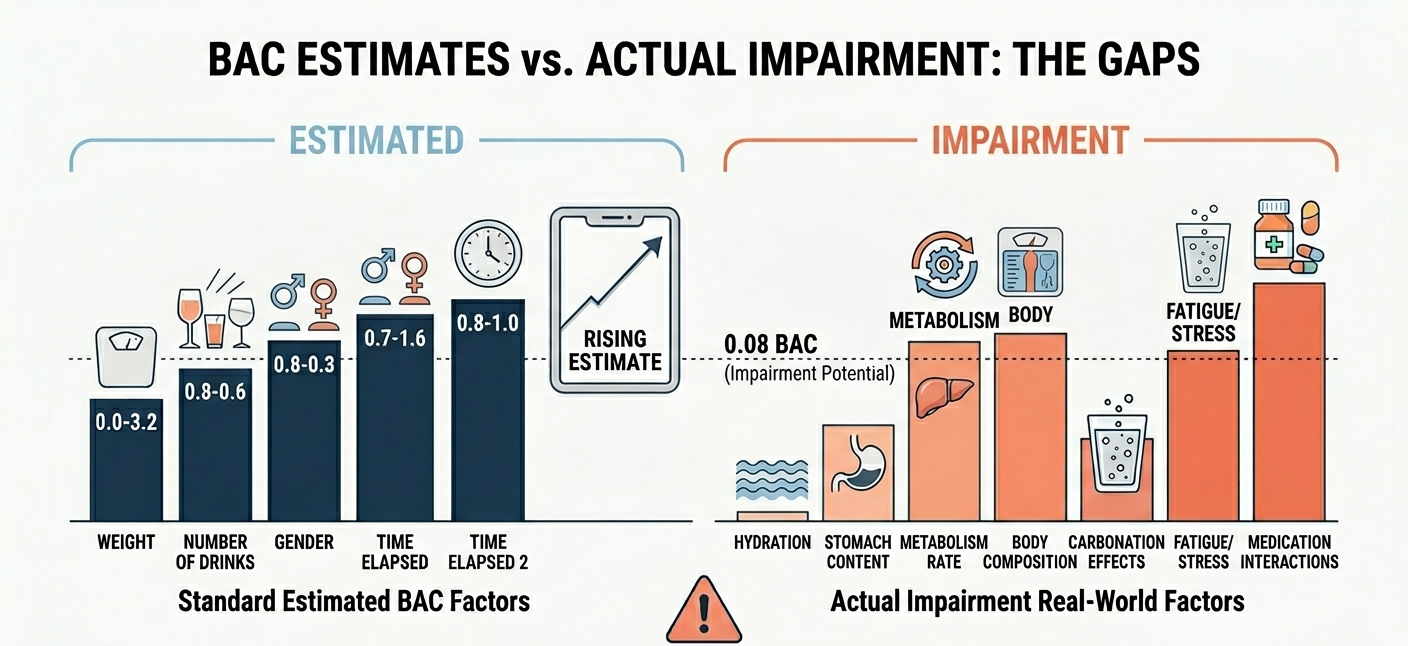
They usually ask for weight, gender, number of drinks, time elapsed. And then they estimate your Blood Alcohol Concentration.
But, here’s the problem – The human body is not an average. And that means two people using the same BAC calculator can receive nearly identical estimates while their actual impairment levels differ significantly.
According to the National Institute on Alcohol Abuse and Alcoholism (NIAAA), alcohol distribution depends heavily on body water composition, metabolism, enzyme activity, and biological differences.
That means body fat matters, muscle mass matters, hydration matters, food matters, carbonation matters and suddenly those neat little BAC charts start looking far less reliable in real-world situations.
Why two 180 lb people can reach the legal limit differently? This is where things become fascinating. Alcohol is water-soluble.
It distributes through body water — not simply body weight and, this is the part most BAC calculators barely explain.
Muscle vs. Fat – The Hidden Difference
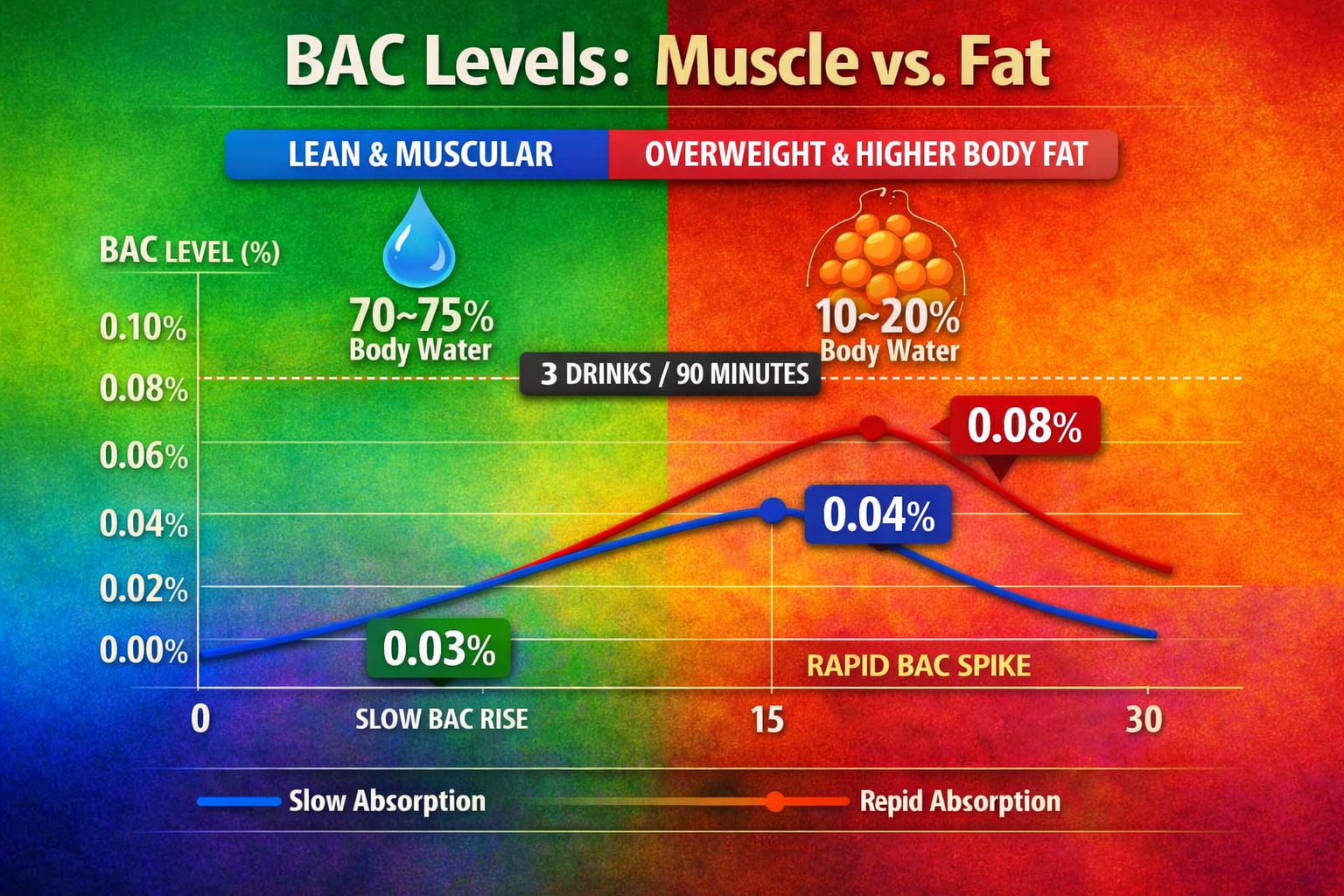
Muscle tissue holds far more water than fat—about 70 to 75 percent compared to just 10 to 20 percent. That difference matters when alcohol enters the body. A leaner person, with more muscle and therefore more total body water, can dilute alcohol more effectively, slowing the rise of their Blood Alcohol Concentration.
Meanwhile, someone with higher body fat absorbs alcohol into a smaller water volume, which means their BAC climbs faster and they reach the legal limit sooner—even if both individuals weigh exactly 180 pounds.
Imagine this – a person weighing 180 lbs, athletic build, low body fat, hydrated after training. Another person weighing 180 lbs, leading a sedentary lifestyle with a higher body fat percentage and, mildly dehydrated after work.
Now both consume – 3 cocktails, over 90 minutes. A BAC chart may estimate similar Blood Alcohol Concentration levels. But biologically, Person B may approach 0.08 BAC significantly faster. Why? Because alcohol has less body water available for dilution.
This is exactly why simplified BAC calculators can become misleading when people treat them like precise scientific tools instead of rough estimates.
The Carbonation Trap Most People Never Notice
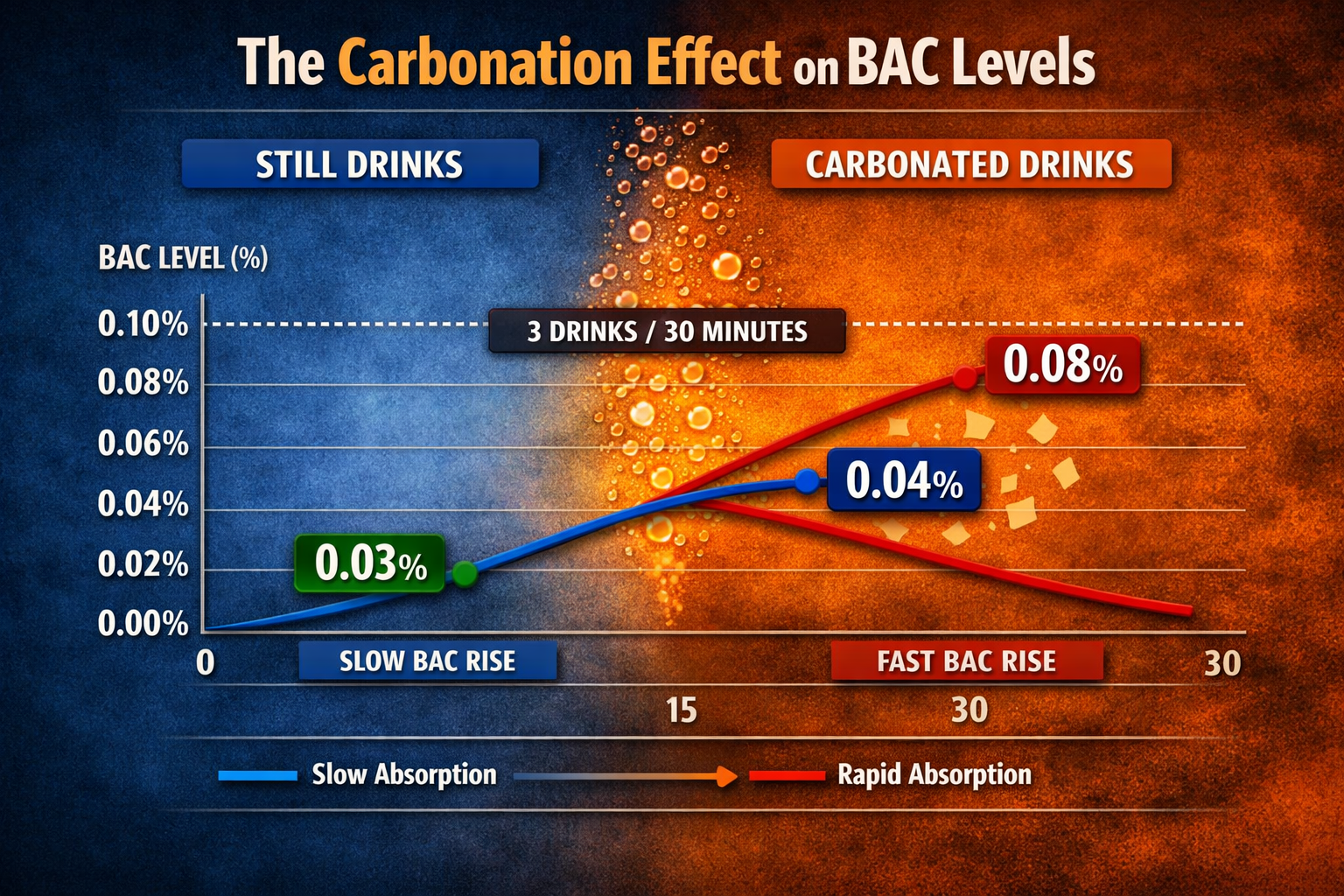
This was the part that honestly surprised me most during my research. Carbonated mixers can increase alcohol absorption speed.
And most people accidentally experience this every weekend without realizing it.
Now, picture two friends at a party. One drinks – whiskey on ice and the other drinks vodka soda. Same alcohol content. Completely different absorption speed.
Studies found that carbonated mixers accelerated alcohol absorption in many participants.
Researchers observed that carbonation may speed up gastric emptying — meaning alcohol reaches the small intestine faster.
And that matters because most alcohol absorption occurs in the small intestine. In practical terms? Carbonation can push someone toward the legal limit faster than expected.
Which means vodka soda, rum and coke, champagne, prosecco may hit harder and faster than people assume.
Even when BAC calculators estimate similar outcomes. Why Champagne Feels “Sneaky”. Almost everyone has heard someone say – “Champagne hits differently.”
That feeling isn’t imaginary. Carbonation changes the delivery system.
Some research and medical discussions have shown higher alcohol absorption rates with sparkling alcoholic beverages compared to still drinks.
So while BAC charts may only count “standard drinks,” the body may process those drinks very differently depending on carbonation. Same alcohol. Different absorption mechanics.
The Empty Stomach Myth Is Only Half True
People love saying – “Just eat before drinking.” But the reality is more complicated than that. The type of food matters enormously.
Imagine two people drinking the same amount. Person A eats pizza, fries, burgers. Person B eats salad, bread. Both technically ate food.
But high-fat meals slow gastric emptying far longer than high-carb meals. That delays alcohol entering the small intestine and delayed absorption means slower BAC increase.
This is another reason why real-world intoxication rarely matches the clean predictions of BAC calculators.
Why Drinking on an Empty Stomach Feels Aggressive
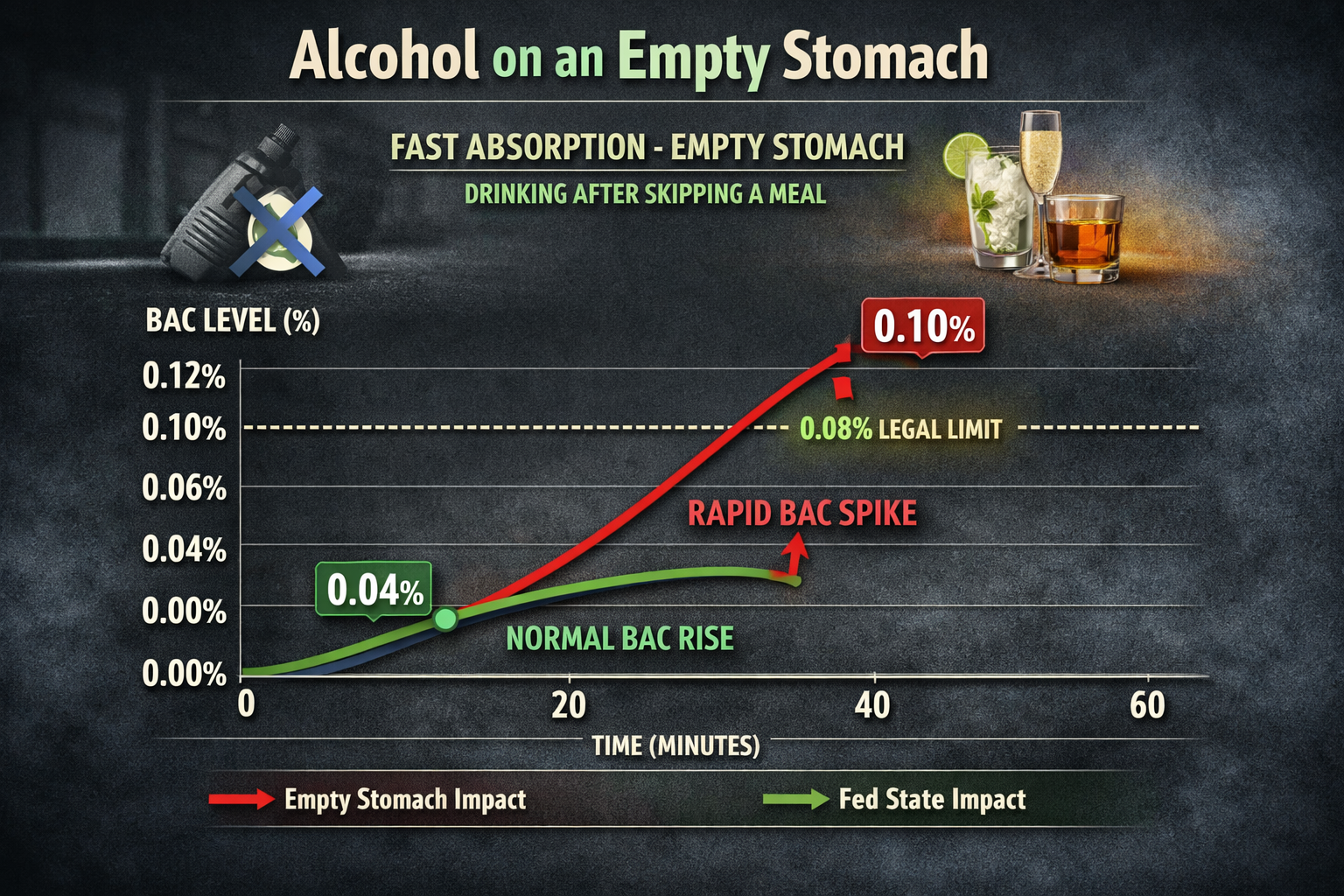
Now imagine someone drinking cocktails, shots, champagne after skipping dinner entirely.
There’s very little digestive resistance. Alcohol reaches the intestine quickly. Absorption accelerates rapidly. Blood Alcohol Concentration spikes harder.
And suddenly someone reaches the legal limit far earlier than expected.
This is why fasting, dieting, dehydration, lack of sleep can dramatically alter how alcohol feels. Even when BAC charts suggest you “should” be fine.
Alcohol is also a diuretic. That means hydration status changes everything. This happens constantly. Someone finishes intense cardio, heavy lifting, a long run, sports practice.
Then goes drinking afterward but now the body is already dehydrated. And because alcohol distributes through body water – BAC may rise faster than normal – same drinks, same person, different biological conditions. Completely different result.
Why “I know my limit” is dangerous? The biggest problem with relying on BAC charts alone is psychological confidence.
People build personal rules like:
“I can handle six drinks.”
“I’m bigger than him.”
“I never get drunk quickly.”
“The BAC calculator says I’m okay.”
But alcohol absorption changes constantly. According to the NIAAA alcohol metabolism research, metabolism varies due to genetics, enzyme activity, nutrition, environmental factors, health status.
Which means your intoxication curve can change from night to night and that’s exactly why relying blindly on BAC calculators can create false confidence.
You Can Check Your BAC — But Understand the Limits
Today, there are countless, BAC calculators, BAC charts, legal limit estimators, alcohol tracking apps, available online and yes, they can be useful as rough educational tools.
You can check your BAC here using trusted alcohol education resources or certified BAC calculators online.
But the keyword is estimate. No BAC calculator can fully account for your hydration, body composition, stomach contents, metabolism, carbonation effects – fatigue, stress, medication interactions.
That’s why estimated BAC and actual impairment are not always the same thing.
That night completely changed how I think about alcohol. Because I realized most people don’t actually understand intoxication.
We simplify it into weight, drink count, BAC charts, legal limit numbers but the human body is far more dynamic than that.
Two people can weigh the same, drink the same, appear similar and still reach 0.08 BAC at very different speeds.
Not because one person is weak not because the other “handles alcohol better.” Because biology is unpredictable.
Wrapping Up
So, that’s how I found out people weighing 180 lbs will reach $0.08 at different speeds. The biggest myth about alcohol is the belief that intoxication follows clean mathematical rules.
It doesn’t. The body is biological, adaptive, and constantly changing. Alcohol absorption depends on body water, muscle mass, body fat, hydration, food composition, carbonation, metabolism, digestion speed and once you understand that – you stop blindly trusting BAC calculators and generic BAC charts as perfect measurements.
Because the legal limit may arrive much faster than you think. Especially when your body processes alcohol differently than the averages those charts were built around.
