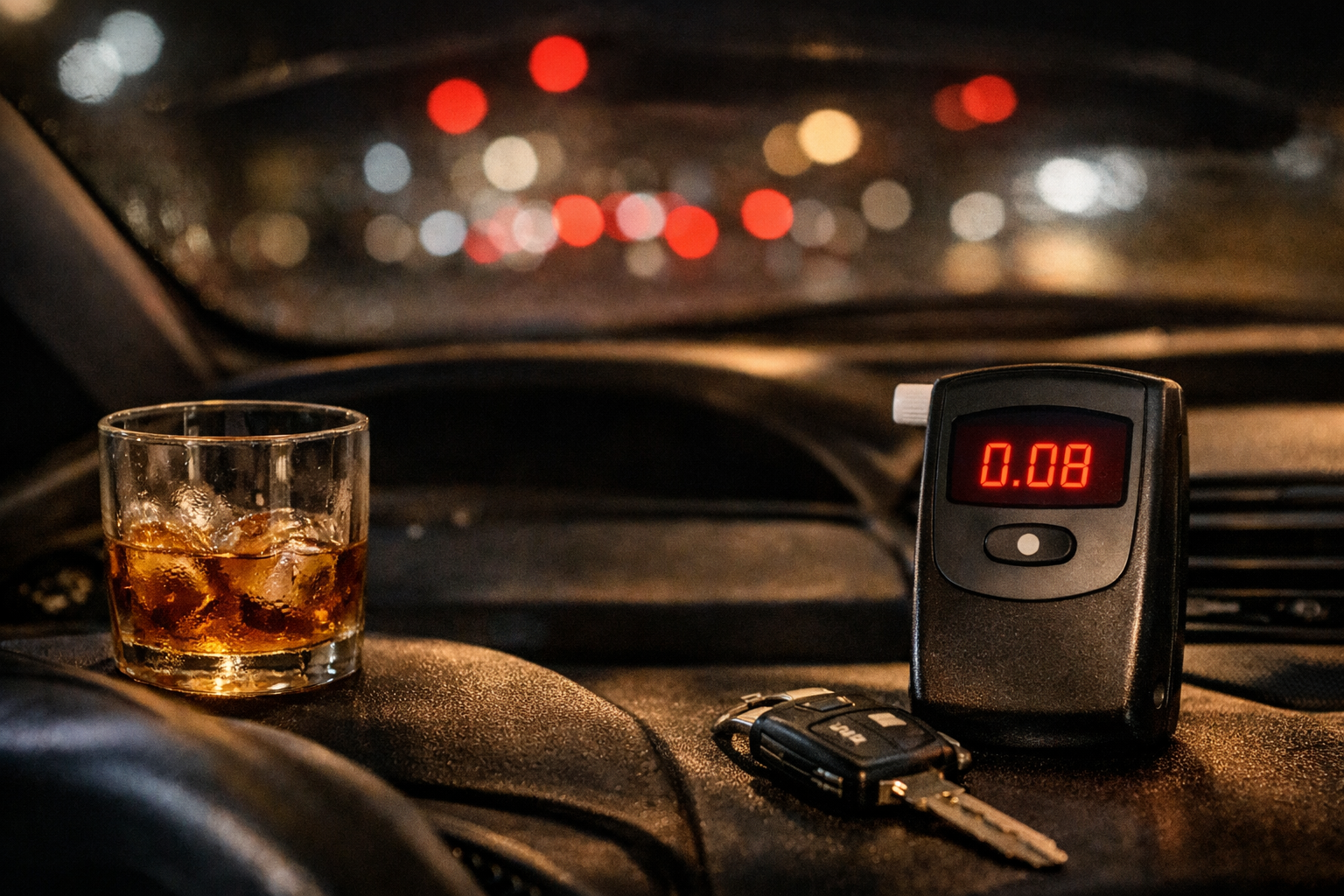
We all know the legal limit—0.08, the number stamped into law as the threshold where impairment becomes a crime. But the truth is, alcohol doesn’t wait for that number. It begins reshaping your judgment and reflexes much earlier, long before a breathalyzer ever says ‘too much. So, impairment starts earlier than the legal limit – 0.08.
The changes begin much earlier, quietly reshaping your judgment, your reflexes, your focus—long before a breathalyzer flashes too much.
Most people ask – How many drinks until I hit 0.08? They pull up a chart, punch numbers into a calculator, and check their BAC. But the truth is, those tools only sketch the outline of a much bigger story.
Because impairment isn’t just about numbers—it’s about the invisible shifts happening inside your brain while you still feel “fine.
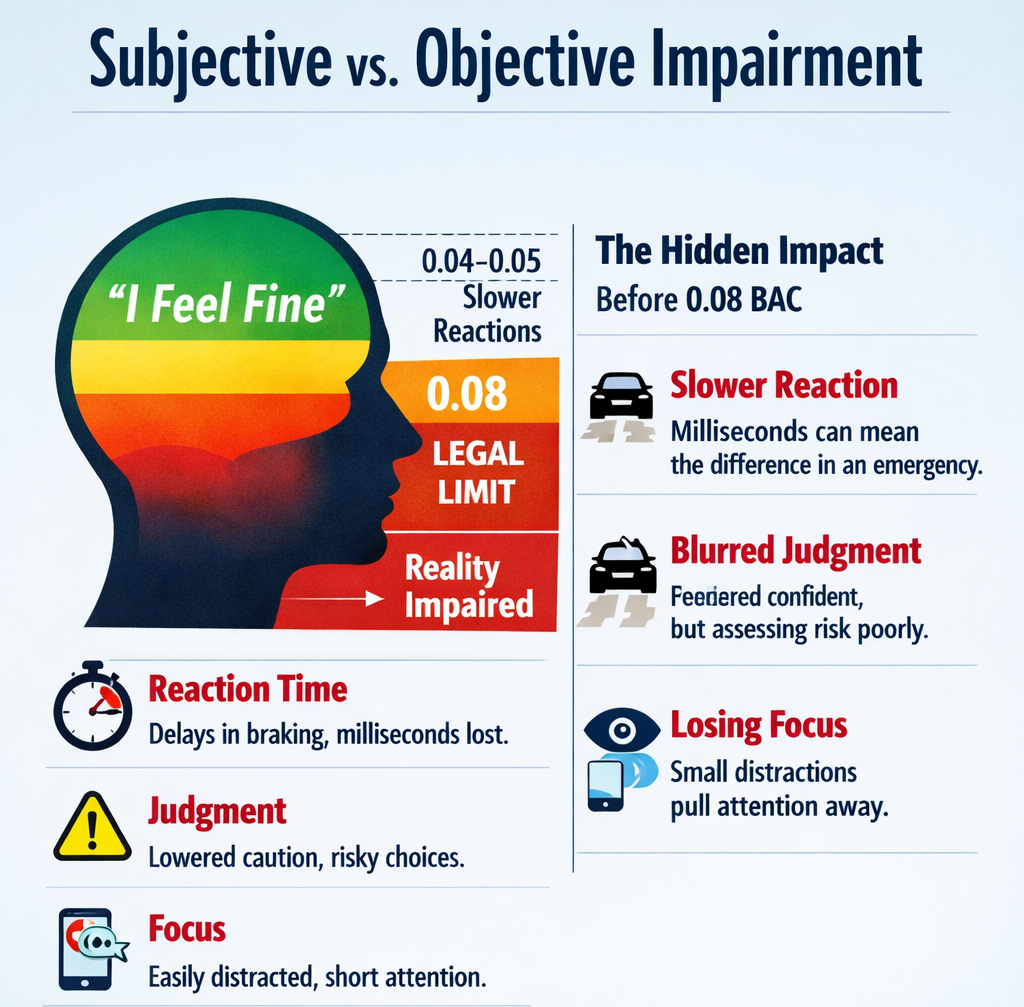
Subjective vs. Objective Impairment
On paper, impairment looks neat & tidy – a number, a threshold, a legal limit. But in reality, it’s messy, personal, and often invisible.
Think of it this way – the law says 0.08 is the point where you’re officially impaired. But your body doesn’t wait for that number. Long before you reach it, subtle changes begin to creep in.
At 0.04–0.05, your reaction times are already slowing. You might not notice it—you still feel “fine”—but your brain is processing information more sluggishly.
Reaction Time – At lower BAC levels, milliseconds are lost in decision-making. On the road, those milliseconds can mean the difference between braking in time or rear-ending the car ahead.
Judgment – Alcohol blurs the edges of caution. You may feel confident enough to drive, even though your ability to assess risk is compromised.
Focus – Distractions become harder to resist. A phone buzz, a passing light, or a stray thought can pull your attention away more easily.
Danger Zone – The gap between subjective experience – I feel fine and objective reality I’m impaired.
A BAC chart might say you’re safe, but your brain is already underperforming. That’s why relying only on how many drinks you’ve had or what a calculator tells you can be misleading.
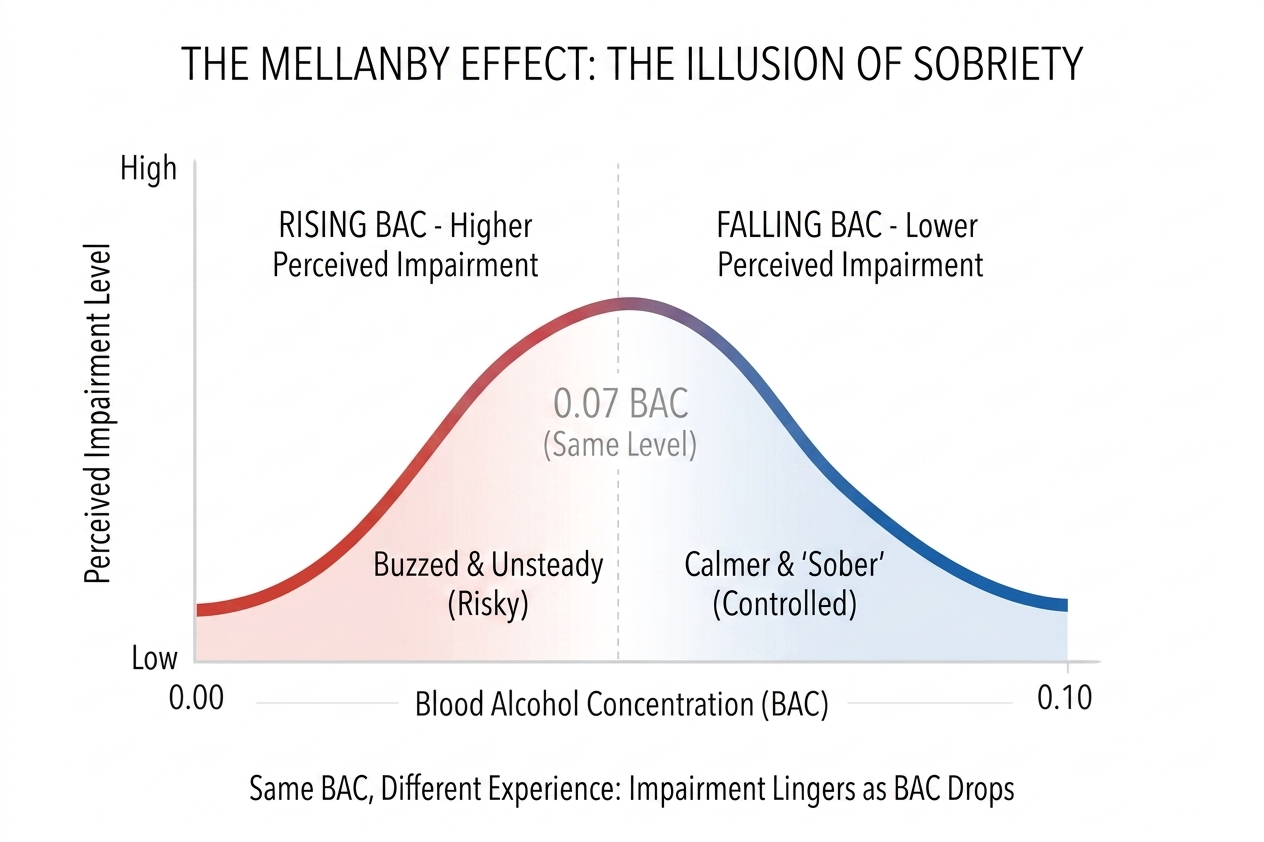
The Mellanby Effect – Rising vs. Falling BAC
Here’s where the story gets even more surprising- the Mellanby Effect.
Imagine this – you’re at 0.07 BAC while your alcohol level is rising. You feel buzzed, unsteady, maybe even reckless.
Later, you’re at the exact same 0.07 BAC, but now it’s falling. You feel calmer, more in control, almost “sober.”
Same number, different experience. Why? Because impairment is greater when BAC is rising than when it’s falling.
On the Way Up – The climb hits harder. Coordination falters, judgment slips faster, and impairment feels stronger.
On the Way Down – The same number feels less impairing. You believe you’re regaining control, even though your reflexes are still dulled.
The Illusion of Sobriety – This is the trap. People often think they’re “fine” once their BAC starts dropping, but the impairment lingers.
This means that even if a BAC calculator shows you’re under the legal limit, your body may still be reacting as if you’re impaired. Although, impairment starts earlier than the legal limit of 0.08.
Charts can’t capture this lived reality. Two identical numbers can feel worlds apart depending on whether your BAC is climbing or falling.
The Micro-Sleeps of 0.05
Tracking 0.08 is a losing game. By the time you hit that number, impairment has already been shaping your decisions for hours.
At 0.04–0.05, something subtle but dangerous happens -the brain begins to slip into micro-sleeps.
At 0.05 BAC, crash risk increases by about 40% compared to sober driving. A driver may miss a stop sign or brake too late.
At 0.04–0.05, students show slower reaction times and reduced focus in lab tests
Cognitive Processing Slows – Your brain takes longer to interpret signals. A red light doesn’t register as quickly, a pedestrian doesn’t stand out as sharply.
Attention Flickers – Focus becomes fragile. You may think you’re paying attention, but your mind drifts in tiny, unnoticed lapses.
Micro-Sleeps – Microsleeps are milliseconds of lost awareness—your brain “blinks” without your permission.
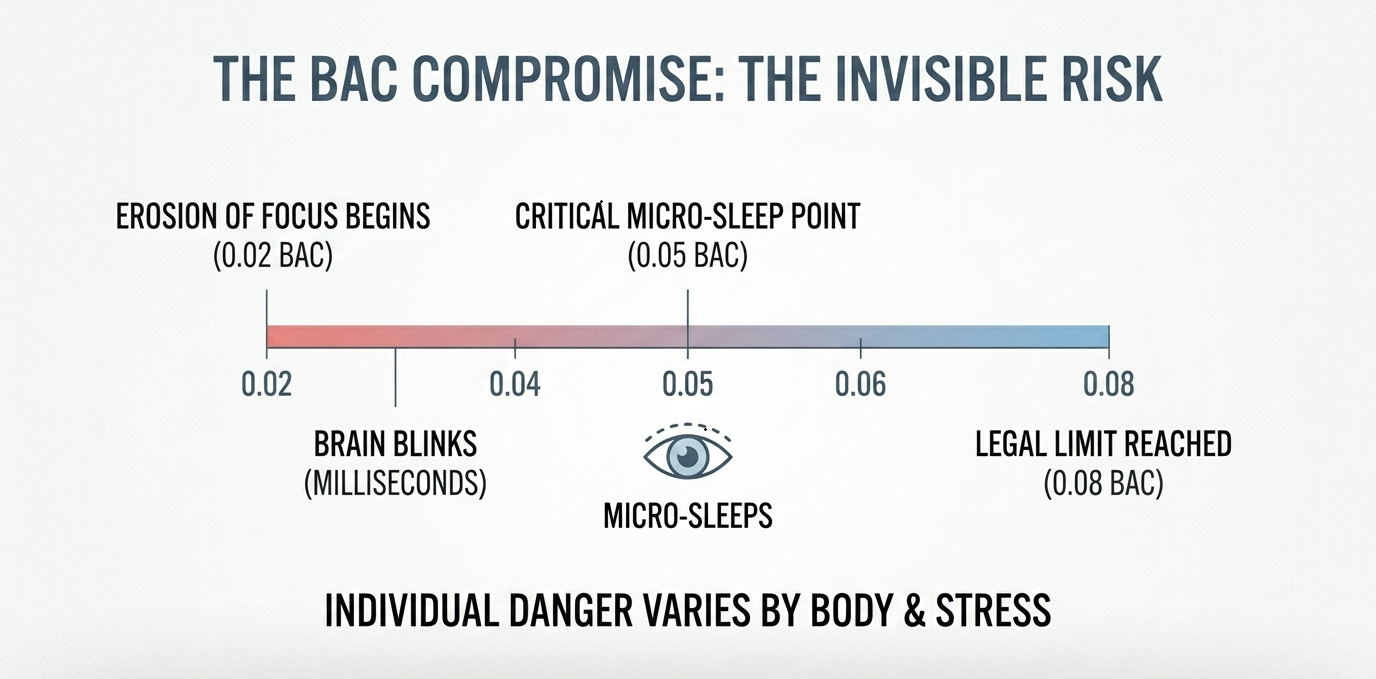
At 60 miles per hour, a micro-sleep can mean traveling the length of a football field without full awareness. It’s not dramatic like passing out—it’s invisible, silent, and deadly.
This is why the legal limit of 0.08 is misleading. By the time you reach it, your brain has already been compromised. The real danger begins earlier, in the quiet erosion of focus and reaction.
And here’s the kicker – how many drinks it takes to reach 0.05 or 0.08 varies wildly. Body weight, metabolism, food intake, and even stress levels change the equation. A BAC chart or calculator can give you an estimate, but it can’t tell you how impaired you feel or how impaired you actually are.
That’s why public health experts often say – Don’t just check your BAC here—listen to your body, too.
The Illusion Behind BAC Charts
The story of alcohol impairment isn’t about a single number—it’s about the hidden ways alcohol reshapes perception, judgment, and reaction long before the law steps in.
Charts and Calculators – They give you numbers, but not the full picture. A chart might say you’re “safe,” yet your brain could already be lagging behind.
How Many Drinks – It’s not a reliable measure. Two people can drink the same amount and end up with very different BACs depending on body weight, metabolism, food intake, or even stress levels.
BAC Checking Tools – Tools can help, but they don’t capture subjective impairment, the Mellanby Effect, or the micro‑sleeps that creep in at lower levels. Numbers alone can’t explain why you feel “fine” while your reflexes are compromised.
Alcohol doesn’t just change your BAC—it changes your experience of control. and impairment starts much earlier than the legal limit of 0.08. That’s the real story – impairment is personal, variable, and often invisible until it’s too late.
Wrapping Up
In the end, the most dangerous part of alcohol isn’t the number on a screen—it’s the confidence it gives you before that number ever looks alarming. Long before the law calls it impairment, your brain has already started to slow, your focus has begun to fracture, and your judgment has quietly shifted.
The danger isn’t 0.08—it’s everything that happens before it. By the time a number says you’re impaired, your brain already is.
Because the truth is, you don’t feel the moment you stop being at your best. So don’t ask, “Am I under the limit?” Ask, “Am I truly okay to drive?” When it comes to safety, the safest number isn’t 0.08—it’s zero.
