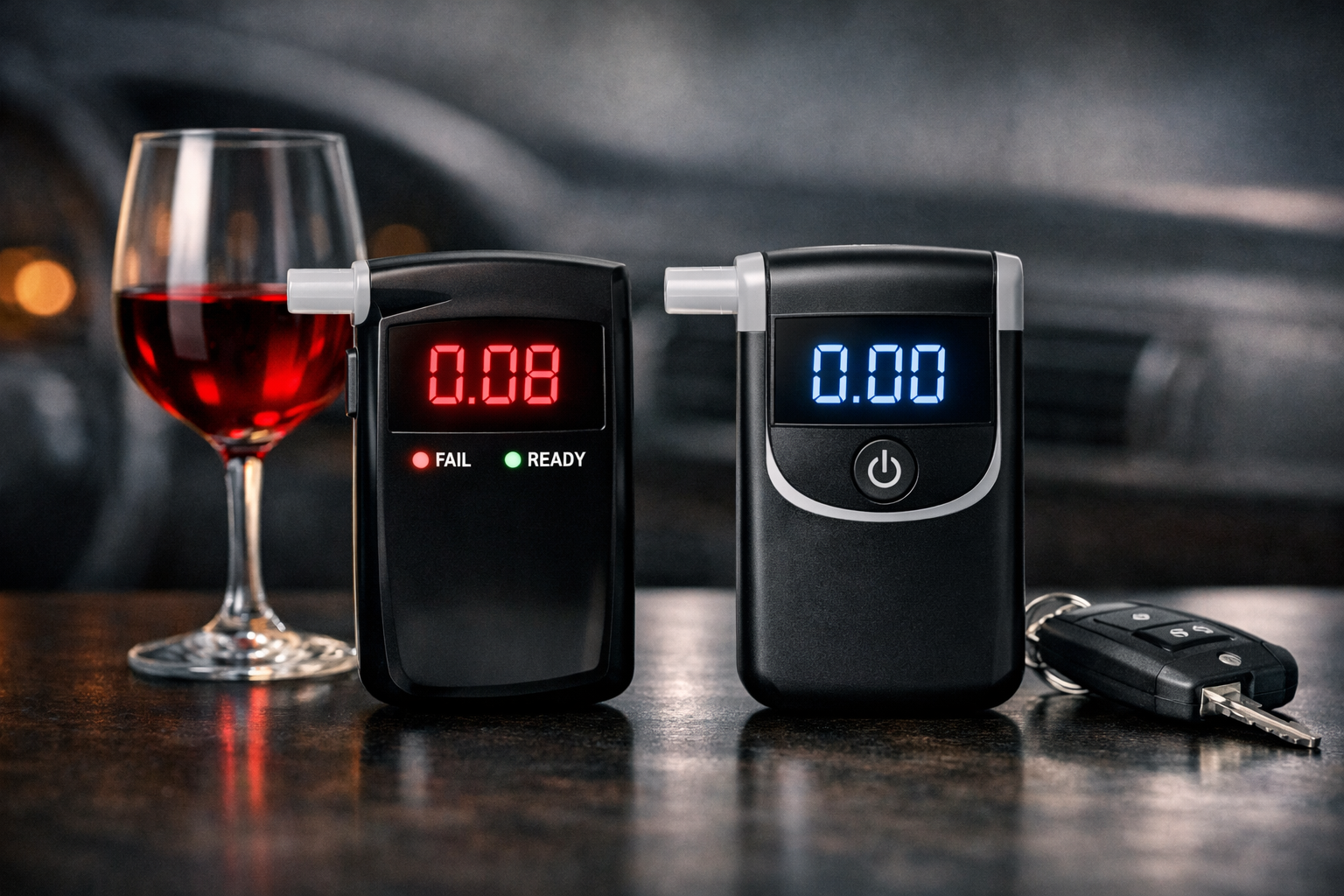
It started in a parking lot outside a wedding reception. Two friends. Same number of drinks, roughly same body weight and, with same confidence.
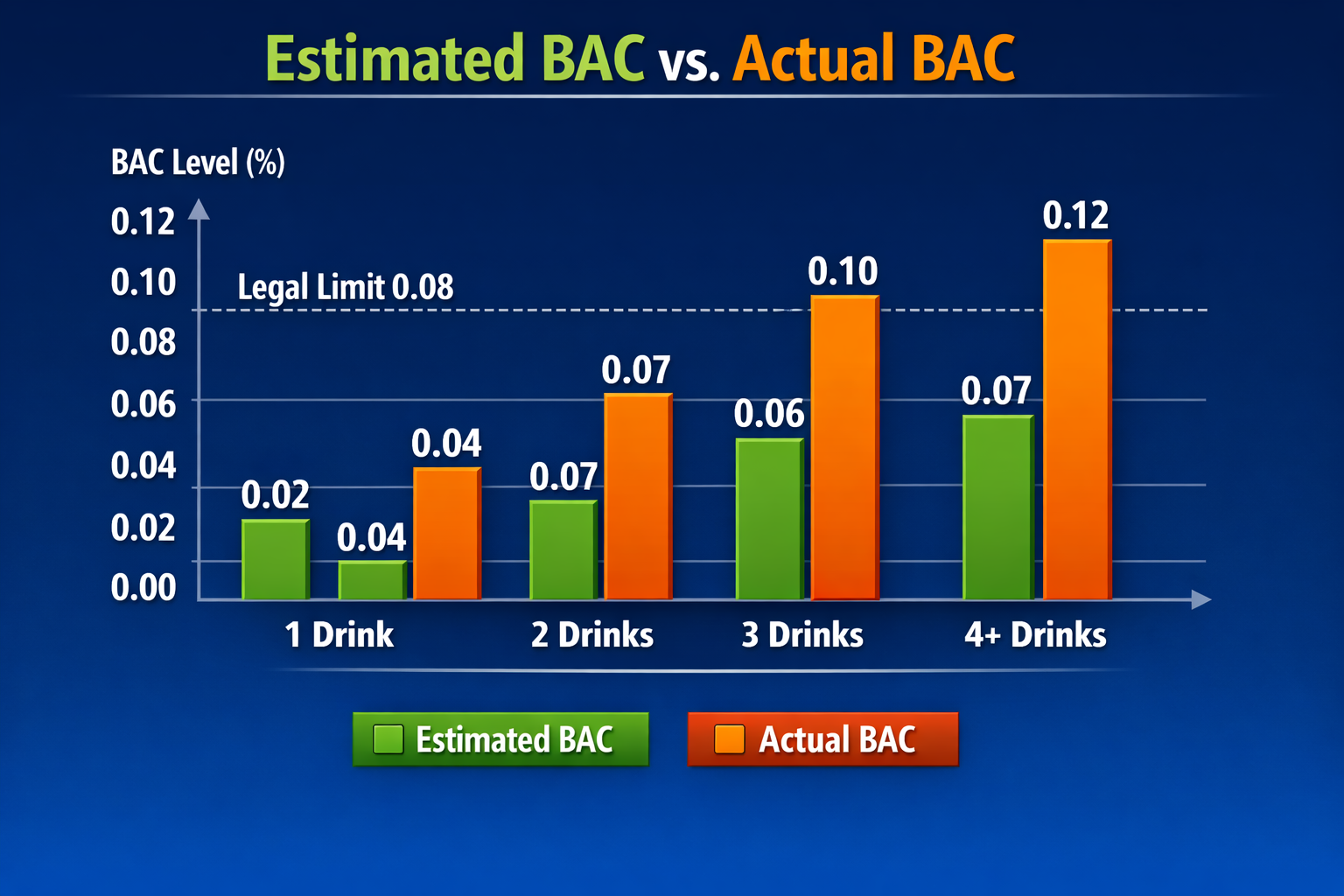
A friend blew into a cheap handheld breathalyzer and smiled.“0.05. I’m fine.” An hour later, a police-grade fuel cell test showed 0.09 BAC — above the legal limit.
That was the moment I realized something most people never think about – Not all breathalyzers measure alcohol the same way.
And the difference between a cheap semiconductor sensor and a professional fuel cell device can completely change the result.
Two people can drink the same amount yet show different BACs — because alcohol absorbs differently depending on food, hydration, stress, and metabolism. Now, here is Semiconductors vs. The Law – The Industrial Reality of Handheld Alcohol Detection.
The Great Lie of “Good Enough” BAC Testing
The handheld alcohol detection market exploded because people wanted convenience.
Apps started offering BAC calculators. Websites published BAC chart estimates. Cheap devices flooded online marketplaces promising accuracy.
But here’s the industrial reality – Not all alcohol sensors are designed to measure alcohol accurately. Some are designed simply to detect something that resembles alcohol. And that distinction matters more than most people realize
At the center of the industry are two competing technologies:
- Semiconductor sensors
- Fuel cell sensors
Most consumers never learn the difference. But law enforcement absolutely does.
The Semiconductor Sensor – Cheap, Fast, and Easily Confused
Semi-conductor sensors dominate the low-cost market because they’re inexpensive to manufacture.
You’ll find them in:
- Budget breathalyzers
- Keychain alcohol testers
- Promotional “smart” alcohol detectors
- Cheap online BAC calculators paired with hardware devices
They work using heated metal oxide sensors that react when certain gases are present. The problemis alcohol isn’t the only thing they react to.
The Hidden Dangers of Cheap Breathalyzers
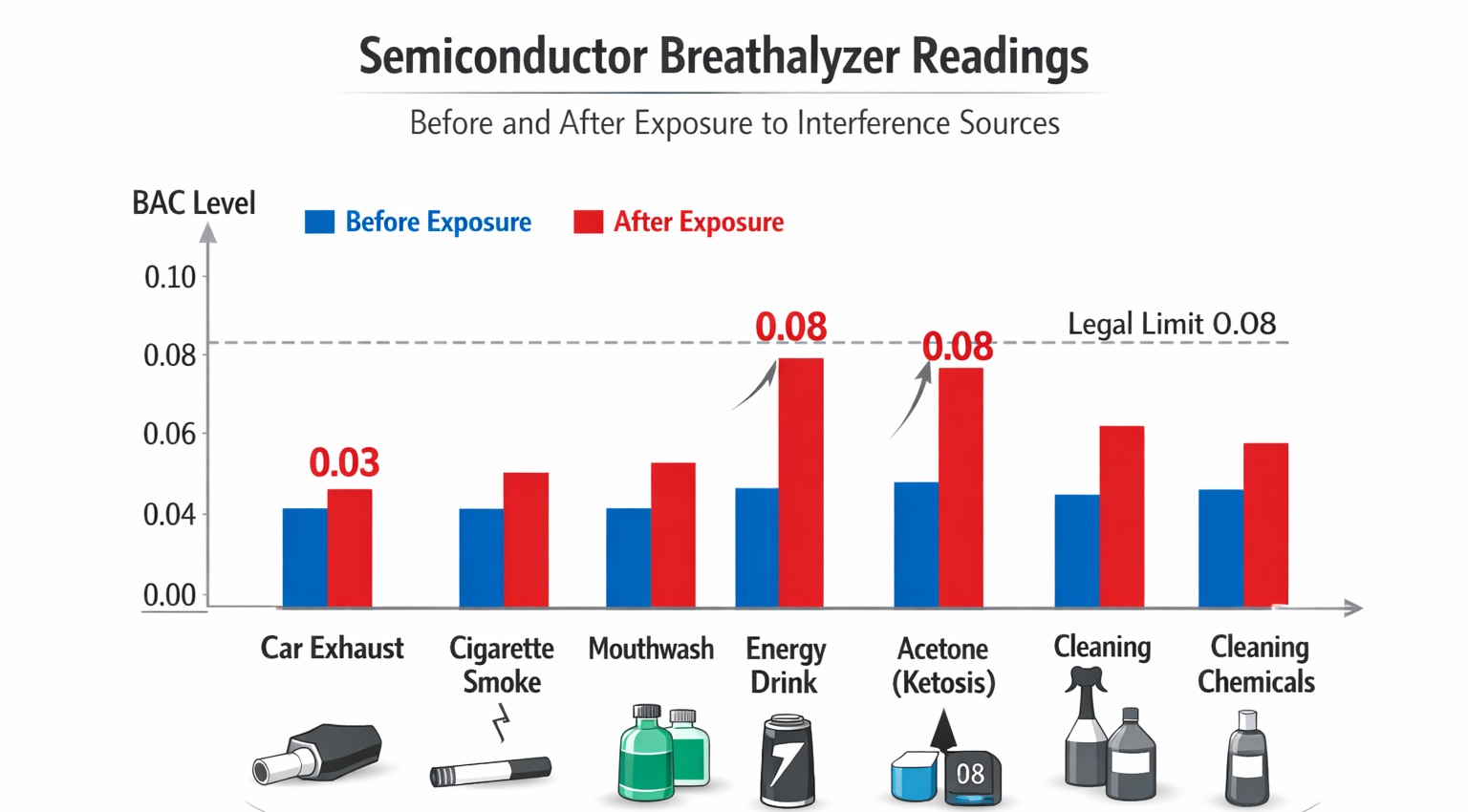
Suppose you set up a handful of low‑cost semiconductor breathalyzers inside a sealed parking garage, expecting them to quietly track alcohol levels.
At first, the numbers look steady, but then you introduce car exhaust, cigarette smoke, a splash of mouthwash, even, the vapors from an energy drink. Suddenly, the readings swing wildly.
One device leaps from 0.03 to the legal limit 0.08 in under two minutes—without a single extra sip of alcohol. Add in acetone from a ketogenic diet, cleaning chemicals lingering in the air, or shifts in temperature and humidity, and the sensors become even more erratic.
Factor in calibration drift and individual metabolic differences, and you realize these cheap devices can be dangerously misleading. What feels like a simple test quickly turns into a chilling reminder – in real‑world conditions, a breathalyzer can declare you legally drunk when you haven’t touched another drop.
Why Semiconductor Sensors Struggle
Semiconductor alcohol sensors are sensitive to multiple volatile organic compounds.
That means they can mistake other substances for ethanol. According to the National Highway Traffic Safety Administration (NHTSA), semiconductor sensors generally show:
- Lower specificity
- Higher calibration drift
- Reduced long-term stability compared to fuel cell technology
- Professional environments rarely trust them for evidential testing. And there’s a reason for that.
The Fuel Cell Revolution
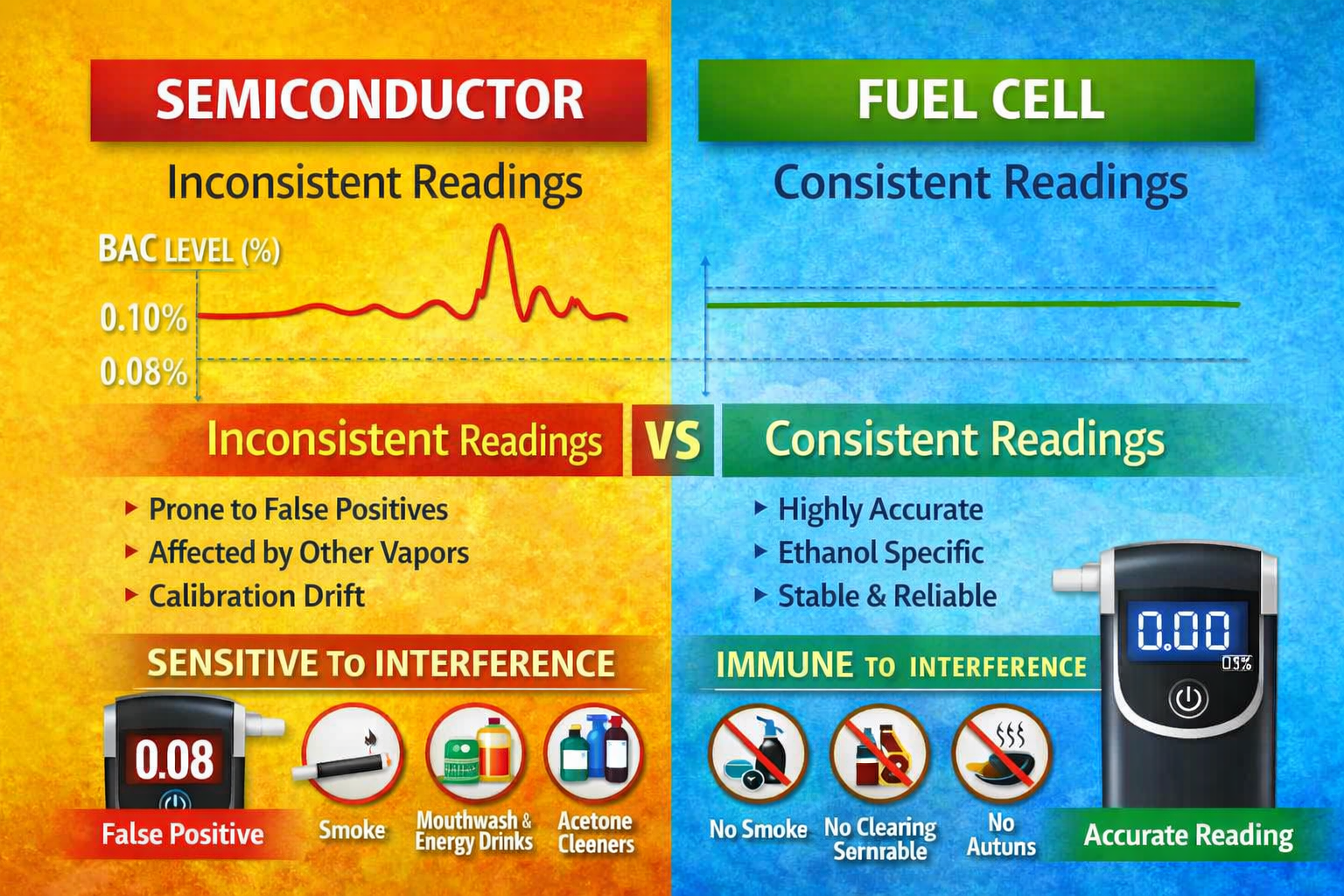
Fuel cell breathalyzers operate completely differently. Instead of broadly reacting to gases, they chemically oxidize ethanol molecules specifically.
This creates:
- Higher accuracy
- Better selectivity
- Lower false positives
- Greater long-term consistency
That’s why professional systems used by:
- Police departments
- Industrial safety teams
- Transportation companies
DOT compliance programs almost always rely on fuel cell technology.
Inside a fuel cell sensor, ethanol creates an electrochemical reaction that generates an electrical current proportional to alcohol concentration.
The key advantage of this is that fuel cell sensors largely ignore substances that confuse semiconductor devices.
That includes:
- Perfumes
- Cleaning chemicals
- Smoke
- Acetone
- Food vapors
This is why professional-grade devices maintain accuracy closer to evidential standards.
The Industrial Reality Most People Ignore
Industrial compliance centers don’t rely on consumer-grade breathalyzers. Every testing station is equipped with calibrated fuel cell systems — the same technology trusted in law enforcement and professional transportation.
Here’s why that matters:
Accuracy over convenience – Fuel cell sensors are far more precise than semiconductor devices, which can be thrown off by temperature, humidity, or even mouthwash.
Legal reliability – A reading of “0.05” on a cheap device when the actual BAC is “0.09” isn’t just a small error — it’s a legal disaster.
Safety culture – Industrial environments recognize that false confidence is more dangerous than uncertainty. A driver who believes they’re safe when they’re impaired poses a catastrophic risk.
In short, professional settings demand instruments that eliminate doubt, because when heavy machinery and human lives are involved, precision isn’t optional — it’s mandatory
BAC Calculators vs. Reality
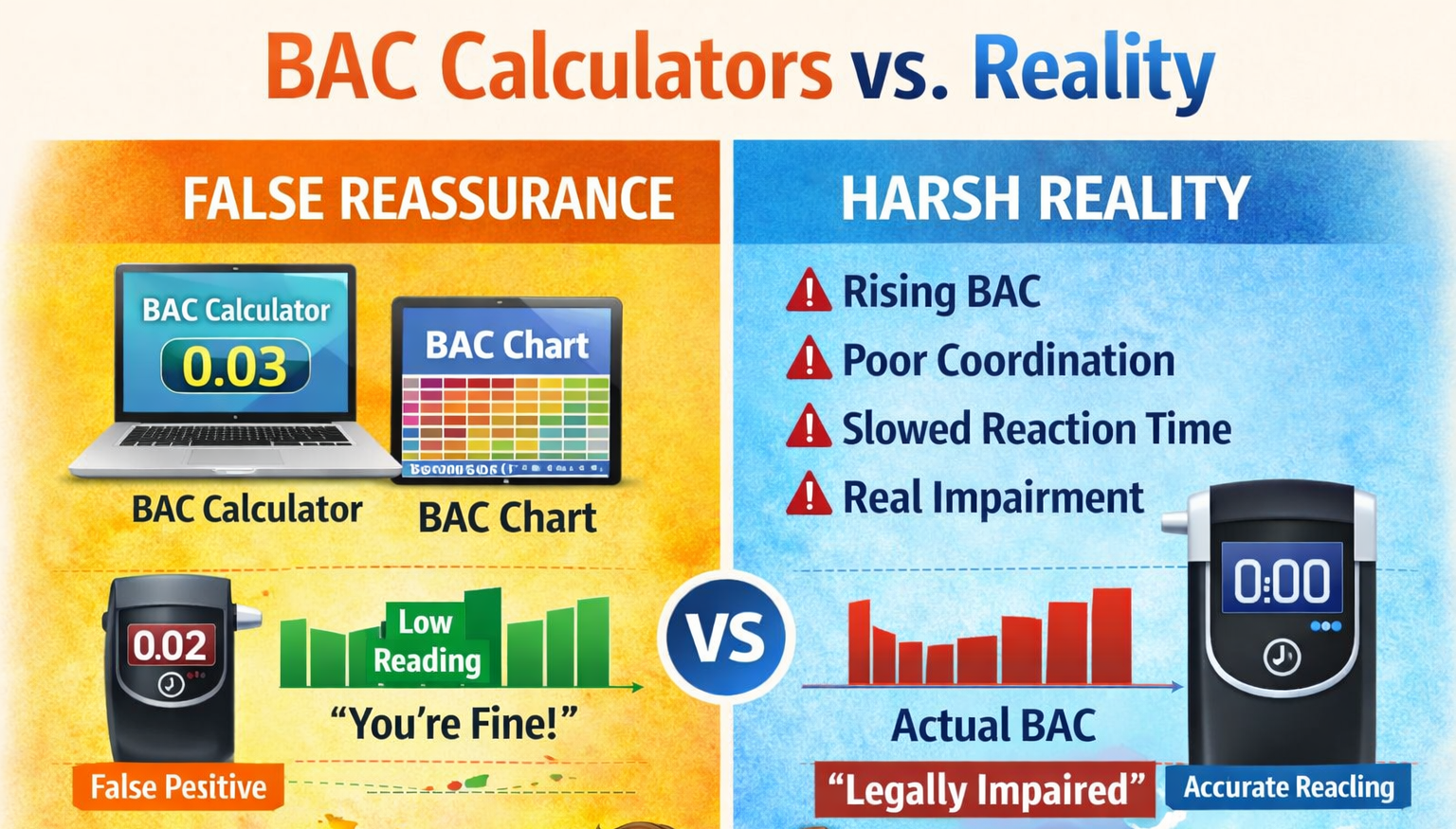
This is where things become even more dangerous. People combine:
- Cheap semiconductor breathalyzers
- Online BAC calculators
- Generic BAC chart estimates and assume they have scientific certainty.
They don’t. A BAC calculator is only an estimate.
A BAC chart is only a rough statistical model. Even professional-grade devices require:
- Calibration
- Controlled testing conditions
- Proper waiting periods
- Correct breathing samples
You can check your BAC here using a professionally designed BAC calculator, however, calculators estimate probability — they do not replace evidential testing.
The human brain becomes worse at judging impairment as impairment increases. Which means the more impaired someone becomes, the more likely they are to trust inaccurate readings – especially if those readings confirm what they want to believe.
This creates a dangerous psychological loop:
- Use cheap tester
- Get low reading
- Feel reassured
- Ignore actual impairment
That’s how bad decisions happen.
The Calibration Problem Nobody Talks About
Semiconductor devices drift badly over time. Even slight sensor degradation changes accuracy.
- Many low-end devices:
- Are never recalibrated
- Lose reliability within months
- Become temperature-sensitive
- Produce unstable readings
Fuel cell systems also require calibration, but they maintain stability significantly longer. That’s one reason police departments maintain strict calibration schedules.
Semiconductor breathalyzers can produce inaccurate BAC readings in cold weather because environmental temperature affects sensor performance. Professional fuel-cell evidential breath analyzers are generally more reliable and are the standard technology used in law enforcement testing.
A discrepancy between a consumer semiconductor device and a professional fuel-cell device can significantly affect the reported BAC level. Even when both readings remain below the general legal limit, the difference may still matter under commercial driving regulations, workplace alcohol policies, or jurisdiction-specific thresholds.
The Legal Limit Is Not a Safety Guarantee
Most countries define a legal limit around 0.08 BAC or, lower depending on region. But impairment begins well before that point.
According to research from the CDC and NHTSA:
- Reaction time slows at low BAC levels
- Visual tracking degrades early
- Decision-making deteriorates before obvious intoxication appears
- The legal limit is a legal threshold — not a biological safety line. That distinction matters.
Why Professional Testing Looks So Strict
If you’ve ever seen official alcohol testing procedures, they seem obsessive. That’s intentional.
- Professional operators:
- Wait before testing
- Avoid mouth alcohol contamination
- Use calibrated fuel cell systems
- Control environmental variables
- Perform repeated sampling
Because accurate alcohol detection is incredibly sensitive. Consumer culture treats BAC testing casually while Industrial safety culture does not.
The Reality Behind Alcohol Detection and Breathalyzer Accuracy
The alcohol detection industry is rapidly evolving with advanced technologies such as multi-sensor verification, AI-assisted correction models, smartphone-connected calibration systems, and passive alcohol detection technologies. These innovations aim to improve the reliability and convenience of alcohol testing.
However, despite technological progress, one fact remains unchanged – accuracy requires high-quality components, proper calibration, and strict testing standards — all of which increase cost.
Many inexpensive breathalyzers compromise on these factors, leading to inconsistent or unreliable readings. Research has shown that some consumer-grade devices may underestimate Blood Alcohol Concentration (BAC), creating a false sense of safety for users.
The biggest misconception about alcohol detection is psychological rather than technological. People often purchase cheap breathalyzers not because they expect laboratory-level precision, but because they seek reassurance.
A low reading may increase confidence even when the device itself is inaccurate. However, alcohol absorption and impairment depend on several biological factors, including metabolism, body weight, hydration, food intake, and individual tolerance.
Neither confidence nor convenience can change the scientific reality of impairment. The law also does not consider whether a device was inexpensive or appeared convincing — legal systems rely on certified testing methods and measurable evidence.
Modern alcohol detection technology includes:
- Multi-sensor verification
- AI-assisted correction systems
- Smartphone-connected calibration
- Passive alcohol detection
- Accurate breathalyzers require:
- High-quality sensors
- Regular calibration
- Controlled testing conditions
- Advanced processing systems
Cheap breathalyzers may:
- Produce inaccurate BAC readings
- Underestimate intoxication levels
- Create false reassurance
Alcohol impairment is affected by:
- Metabolism
- Body weight
- Hydration
- Food consumption
- Individual tolerance
The law and human biology are based on measurable reality, not user confidence or convenience. Because when it comes to alcohol absorption, impairment, and the legal limit, reality always wins.
Wrapping Up
The story of handheld alcohol detection is about trust. Cheap semiconductor breathalyzers may offer convenience, but they’re easily misled by fumes, chemicals, and calibration drift.
Fuel cell technology delivers the accuracy and reliability that safety, legality, and human lives demand — because in this perspective, good enough is never enough.
