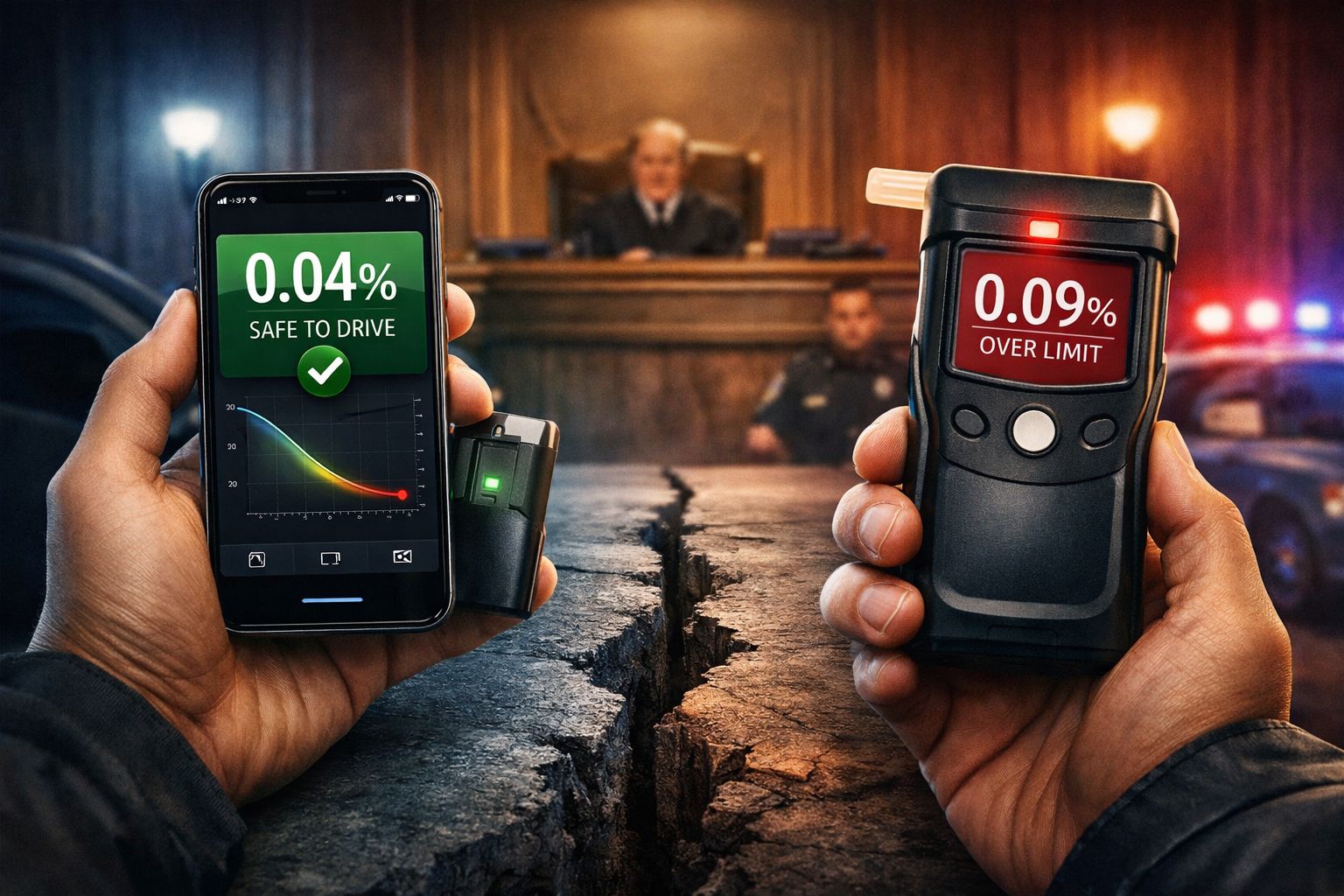
Picture this – you’re sitting in your car, checking a sleek little app connected to your Bluetooth breathalyzer. It flashes green—BAC 0.04%, under the legal limit.
You feel reassured. Ten minutes later, blue lights fill your mirror. The officer’s certified device reads 0.09%.
Suddenly, your phone says one thing, the state says another. And in that moment, the question becomes brutally clear – which number matters in court? This is where modern technology collides with an old legal reality.
Because while your device may track data, generate charts, and predict impairment, in the courtroom it often means nothing. That gap—the admissibility gap—is the dangerous space where digital confidence meets analog law.
The Rise of the Pocket Breathalyzer
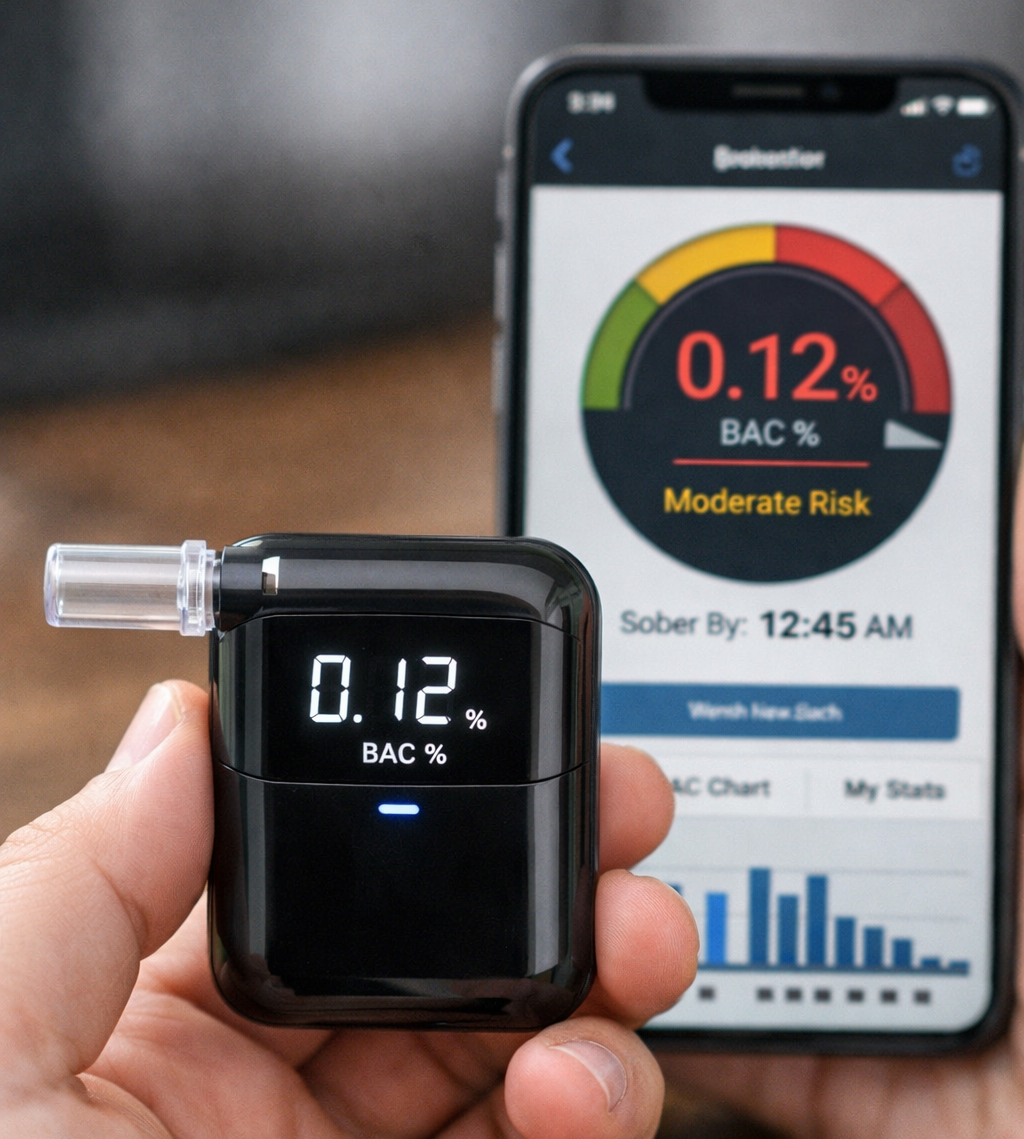
Over the last few years, personal breathalyzers exploded in popularity. Tiny Bluetooth analysers now connect directly to smartphones.
Some devices promise:
- Police-grade accuracy
- AI tracking
- BAC charts
- Real-time alcohol monitoring
- Driving recommendations
- Metabolism estimates
- Smart notifications
- Built‑in BAC calculators that estimate your level based on drinks, weight, and time elapsed
And honestly, the technology feels convincing. The apps look professional. The graphs look scientific. Some even tell users exactly when they’ll supposedly fall below the legal limit.
That creates a dangerous illusion – That personal alcohol tech equals legal certainty. But those are two very different things.
The Moment Technology Creates False Confidence
Now imagine someone leaves a party after two glasses of wine. Before driving, she checks her personal breathalyzer.
The app estimates BAC – 0.05%. The chart inside the app even predicts she’ll drop lower within 20 minutes. So she waits. Checks again. 0.04%. Under the legal limit.
Everything looks safe. But what if the person doesn’t realize is that consumer breathalyzers often operate under completely different standards than evidentiary police analysers. We often cannot outsmart the law with personal breathalyzers. And this difference matters enormously. Because roadside analysers are built around:
- Certified calibration
- Chain-of-custody requirements
- Legal certification standards
- Mandatory maintenance schedules
- Regulatory compliance testing
Meanwhile, many consumer devices prioritize:
- Convenience
- Portability
- Affordability
- App integration
- User experience
Not courtroom admissibility and that gap between digital convenience and legal recognition is where people get blindsided.
The Admissibility Gap – Why Your Device May Mean Nothing in Court
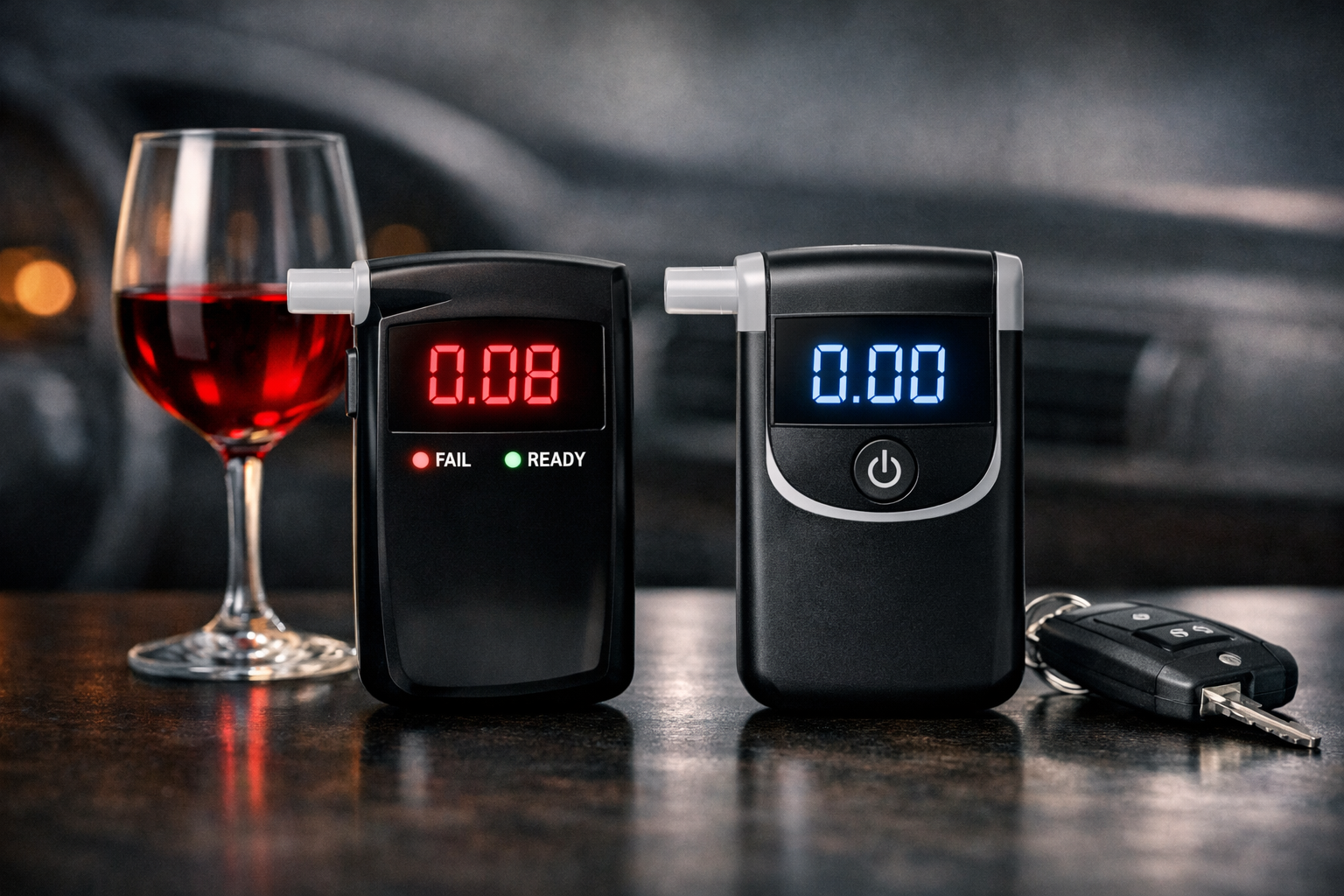
This is the core issue. Your personal breathalyzer data may feel scientific. But courts often care less about consumer technology and more about Evidentiary standards.
This creates what many legal experts describe as an Admissibility Gap. Meaning a device can generate data. Without generating legally accepted evidence. That distinction changes everything.
Because in court, judges typically ask questions like – Was the analyser certified?
Was it calibrated properly? Was the testing procedure standardized? Is the device approved under state law? Can calibration records be verified? Was the operator trained? and so, on…
Most consumer breathalyzers fail several of these requirements immediately. Even expensive ones. And suddenly your smartphone chart becomes legally weak compared to the state’s certified analyser.
Digital Evidence Meets the Analog Courtroom
Now this is where things become almost surreal. Modern life revolves around digital evidence. Phones track location. Watches monitor heart rate. Cars record driving behavior. Apps estimate BAC levels using sophisticated BAC calculators.
Yet many courtrooms still operate through older evidentiary frameworks designed long before consumer digital diagnostics existed.
So while your breathalyzer app may produce:
- Charts
- Timestamps
- Historical BAC logs
- Alcohol consumption estimates
The courtroom may still treat it as little more than personal consumer data. Not forensic evidence.
And this creates a strange conflict between technology and law. Because, consumers increasingly trust digital systems emotionally. Even when the legal system does not trust them formally.
The Problem With BAC Calculators
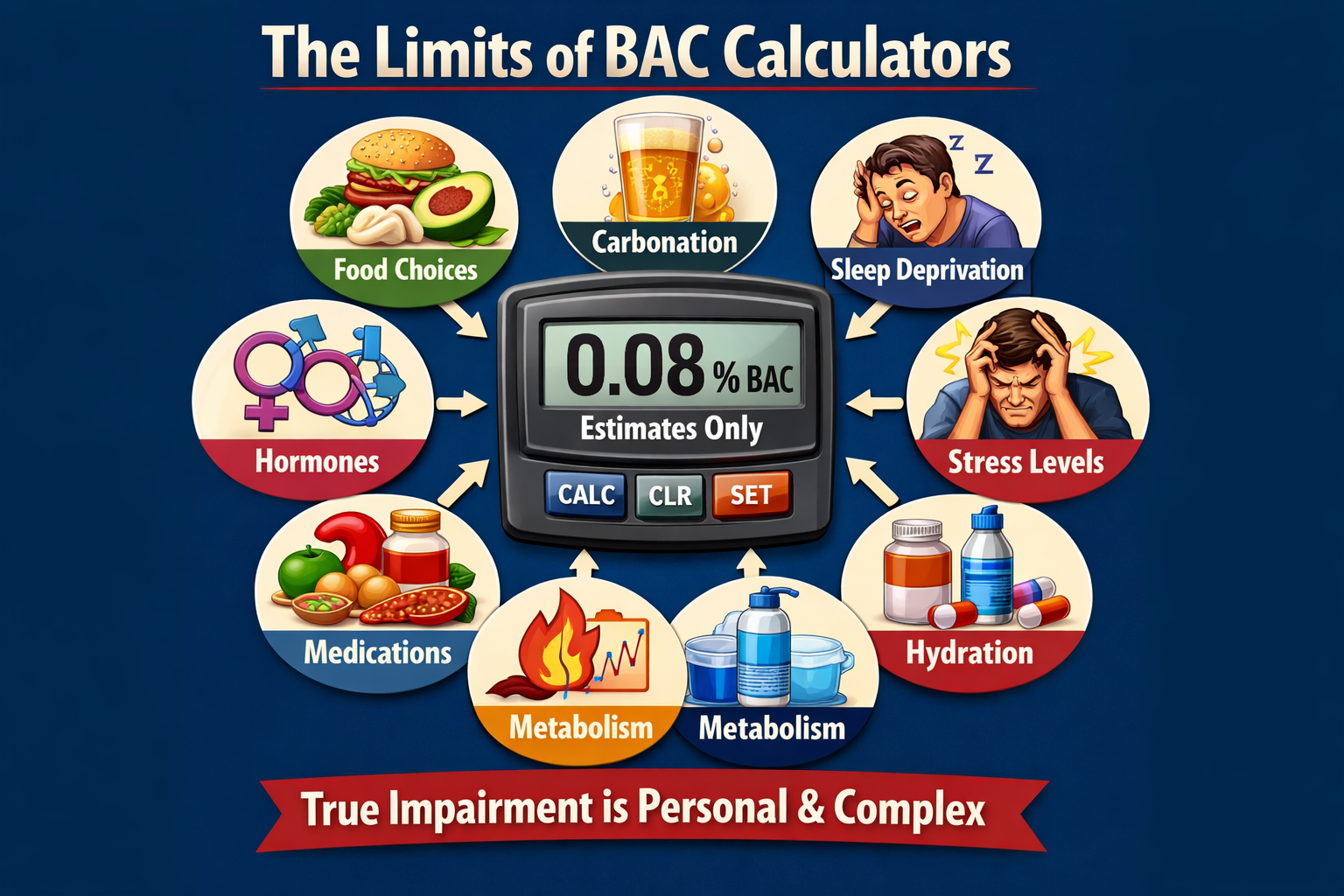
Now, let’s talk about BAC calculators specifically. Because millions of people use them. Apps ask for:
- Weight
- Gender
- Drink count
- Time elapsed
Then they generate estimated BAC values and charts. The problem? These systems rely on generalized mathematical assumptions. They cannot perfectly account for:
- Metabolism differences
- Food intake
- Medications
- Biological variability
- Hydration
- Sleep deprivation
- Body temperature
- Alcohol absorption variability.
So, while BAC calculators may provide rough estimates. They are not reliable enough for high-stakes legal decisions. And relying on them can create a false sense of security. Especially near the legal limit.
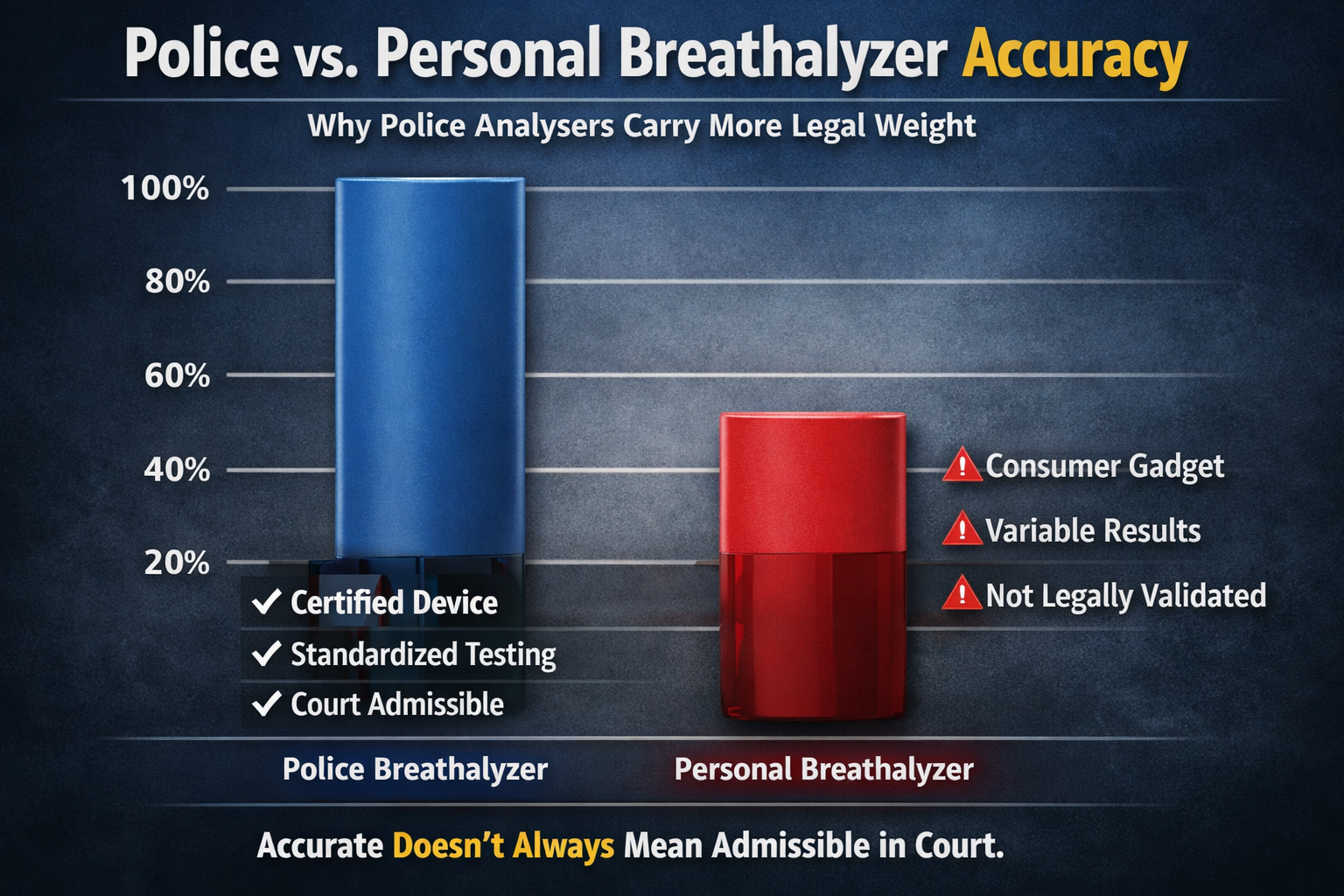
Why Police Analysers Carry More Legal Weight
Now, to be fair, police breath testing isn’t flawless either. Breathalyser science itself contains known biological variability issues. But legally, evidentiary analysers have one massive advantage – Institutional trust.
The legal system recognizes them because they operate inside regulated frameworks.
That includes:
- Approved hardware
- Standardized procedures
- Certification requirements
- Audit records
- Maintenance documentation
Your personal analyser might technically be accurate on a good day. But accuracy alone does not automatically create admissibility. And that’s the part many consumers never realize until it’s too late.
The Dangerous Psychology of “Safe Enough”
This is where the real danger appears. Consumer alcohol tech often changes behavior psychologically. People stop asking – “Should I drive?” And start asking “What does the number say?”
That shift matters enormously. Because once someone sees a BAC reading below the legal limit, they may feel officially cleared to drive.
Even though:
- The device could be inaccurate
- Alcohol absorption may still be rising
- The analyser may be uncalibrated
- Impairment can still exist below legal thresholds
And this becomes especially risky when users treat apps and charts as legal authority rather than rough estimation tools.
The Courtroom Problem Nobody Thinks About
Now imagine Jake from earlier standing in court. His lawyer presents the app screenshots. The BAC chart. The timestamp. The Bluetooth analyser log. And the prosecution responds – That device is not certified for evidentiary use.
Suddenly, all the digital sophistication collapses into one brutal legal reality – Consumer technology is not automatically courtroom technology.
And courts generally prioritize certified state-approved analysers over privately generated consumer data. That doesn’t mean personal devices are useless. But it does mean they may not protect someone legally the way users assume they will.
When Personal Breathalyzers Can Still Be Useful
Now, despite all these limitations, personal breathalyzers are not meaningless. They can still serve valuable purposes.
For example:
- Encouraging safer decisions
- Raising alcohol awareness
- Showing rising BAC trends
- Preventing obviously dangerous driving situations
A decent analyser may help someone recognize – “I’m absolutely not okay to drive.” That alone has value. The problem begins when users mistake – Consumer estimation for legal certainty because those are not the same thing.
The Bigger Conflict Between Technology and Law
This entire issue reflects a broader modern problem. Technology evolves faster than legal systems. Consumers now carry sophisticated diagnostic devices in their pockets.
But legal standards still depend heavily on institutional certification and controlled evidence procedures. So we end up in this strange world where your phone can monitor your heartbeat continuously.
But your BAC app may still be treated as legally irrelevant during a DUI case. That tension between digital evidence and the analog courtroom is only going to grow larger in the future.
Especially as consumer analysers become smarter, cheaper, and more widespread.
Wrapping Up
The scariest part about personal breathalyzer technology isn’t necessarily inaccuracy. It’s confidence. Alcohol absorption changes over time. And legally your analyser may carry almost no authority compared to a state-certified device.
That’s the admissibility gap. A world where technology can feel scientifically convincing. While remaining legally invisible.
So maybe the real lesson isn’t whether personal breathalyzers are good or bad. Maybe it’s understanding what they actually are useful awareness tools, not courtroom shields.
