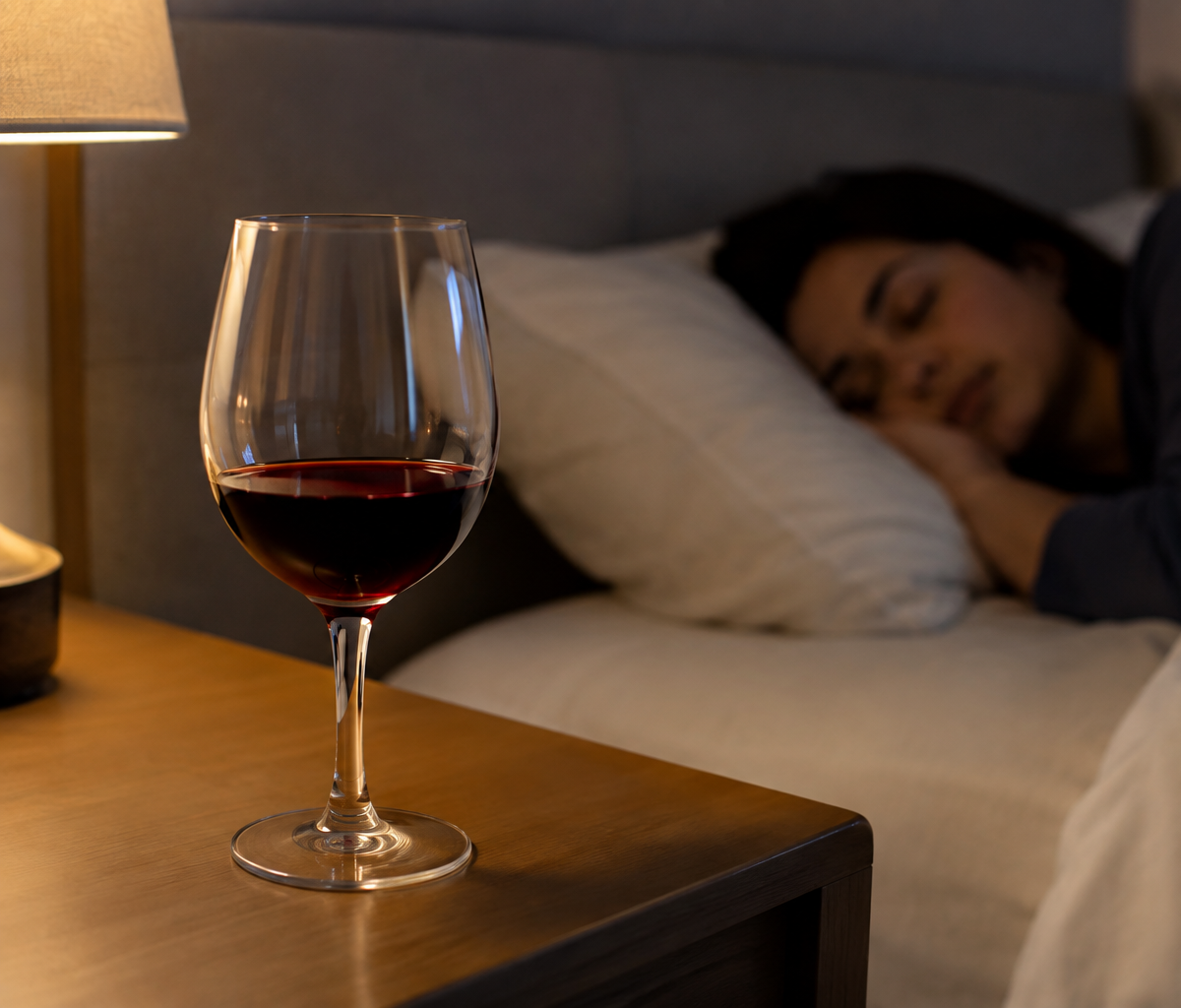
Have you ever had a drink in the evening, felt relaxed and sleepy, and expected to sleep peacefully through the night—only to wake up several hours later feeling restless, thirsty, or unusually tired?
This experience is more common than many people realize. Alcohol can make you feel drowsy and may help you fall asleep faster, but that does not mean it improves your overall sleep quality. In fact, alcohol can interfere with your natural sleep cycle, reduce REM sleep, increase nighttime awakenings, and leave you feeling less refreshed the next morning.
Understanding the relationship between alcohol, blood alcohol concentration (BAC), and sleep can help explain why feeling sleepy after drinking is not the same as getting restorative rest.
In this guide, we will discuss how alcohol affects the brain during sleep, why symptoms often appear later in the night, how BAC calculators relate to alcohol metabolism, and what you can do to improve your sleep after drinking.
Does Alcohol Actually Help You Sleep?
Alcohol is a central nervous system depressant. It changes brain activity and influences neurotransmitters involved in relaxation, alertness, and sleep.
After drinking, you may notice that your body feels relaxed, your thoughts seem slower, and falling asleep feels easier. These effects can create the impression that alcohol is an effective sleep aid.
However, falling asleep quickly and sleeping well are two different things.
Alcohol can initially increase sleepiness by enhancing the activity of gamma-aminobutyric acid (GABA), a neurotransmitter that reduces activity in parts of the brain. At the same time, alcohol affects other chemical systems that regulate alertness and normal sleep patterns.
As your body processes alcohol, these effects change. Sleep may become lighter and more fragmented, especially during the second half of the night.
Research examining alcohol’s effects on sleep has found that even relatively low doses can reduce REM sleep, with disruption generally becoming more pronounced as alcohol consumption increases.
The key takeaway is simple: alcohol may make you fall asleep faster without helping you achieve better-quality sleep.
How Alcohol Changes Your Natural Sleep Cycle
To understand why alcohol disrupts sleep, it helps to know how normal sleep works. Sleep is not a continuous state of unconsciousness. Your brain moves through different stages throughout the night, and each stage contributes to physical recovery, memory, learning, and emotional regulation.
The main stages include:
- The transition between wakefulness and sleep.
- A period of established sleep that makes up a substantial portion of the night.
- Deep sleep, which supports physical recovery and other restorative processes.
- A stage associated with vivid dreaming, memory processing, and emotional regulation.
These stages repeat in cycles, with the amount of REM sleep generally increasing toward the morning.
Alcohol can change the timing and distribution of these stages. Early in the night, it may increase deep sleep while suppressing REM sleep. Later, as its sedative effects diminish, sleep can become more fragmented.
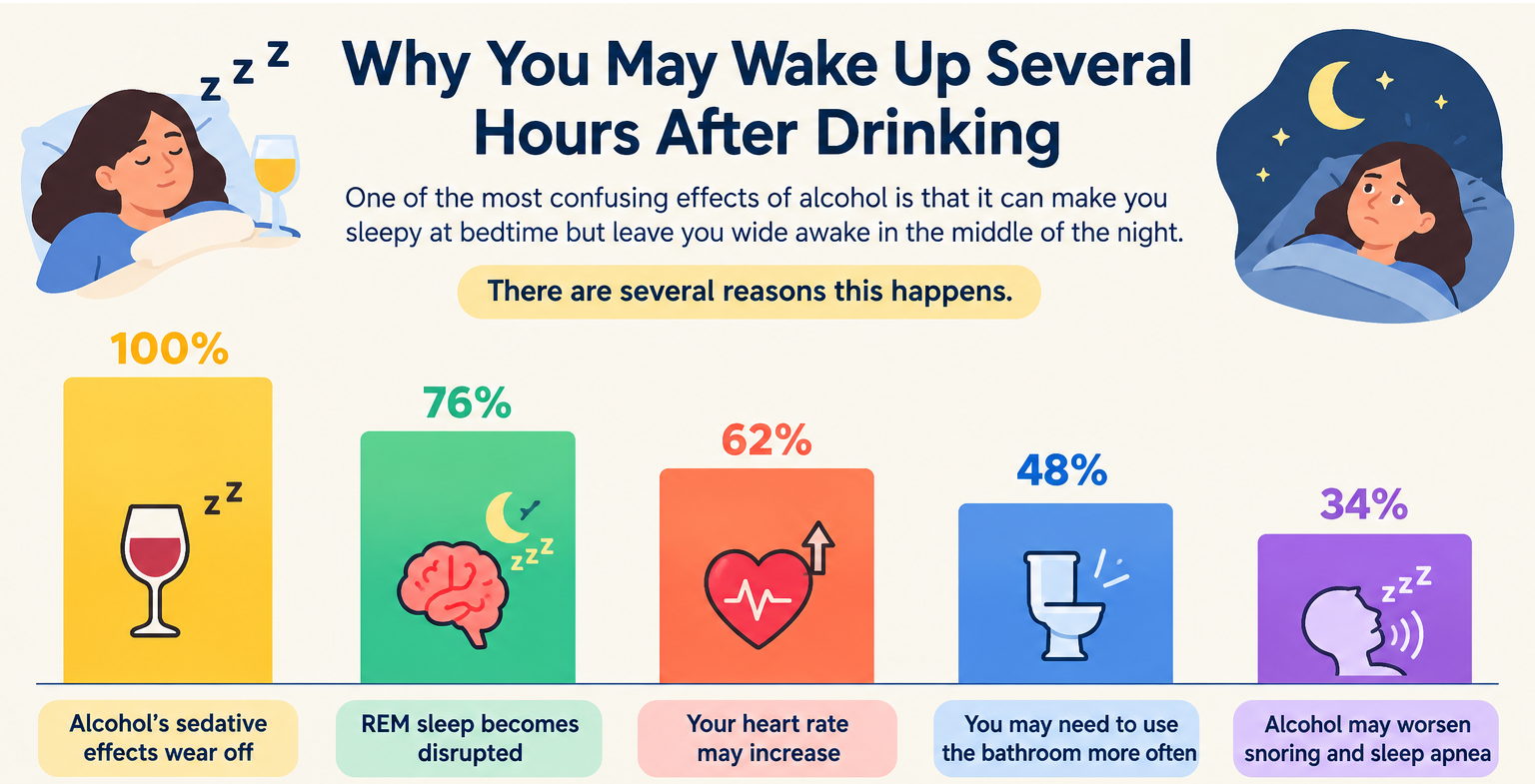
Why You May Wake Up Several Hours After Drinking
One of the most confusing effects of alcohol is that it can make you sleepy at bedtime but leave you wide awake in the middle of the night.
There are several reasons this happens.
- Alcohol’s sedative effects wear off
- REM sleep becomes disrupted
- Your heart rate may increase
- You may need to use the bathroom more often
- Alcohol may worsen snoring and sleep apnea
Does a Higher BAC Always Mean Worse Sleep?
In general, greater alcohol exposure can produce more pronounced sleep disruption, but the relationship is not perfectly predictable for every individual.
Factors that can influence the effects include:
- Amount consumed: More alcohol generally produces greater exposure.
- Drinking speed: Consuming several drinks quickly can cause BAC to rise more rapidly.
- Timing: Drinking close to bedtime increases the likelihood that alcohol will still be affecting you when you sleep.
- Food intake: Food can slow alcohol absorption, although it does not prevent impairment or eliminate alcohol’s effects.
- Individual differences: Body composition, metabolism, medications, health conditions, and alcohol sensitivity can affect the response.
- Existing sleep problems: People with insomnia or sleep apnea may be especially affected.
A BAC chart can help illustrate how alcohol concentration may change over time, but it should not be interpreted as a universal timetable for recovery.
For instance, two people may stop drinking at the same time but have different BAC levels several hours later. Their sleep may also differ, even if their estimated BAC values are similar.
The amount of alcohol consumed matters, but it is not the only factor that determines how well you sleep.
How Much Time Should You Leave Between Drinking and Bedtime?
There is no universally reliable number of hours that guarantees alcohol will have no effect on sleep.
Some sleep-health guidance recommends avoiding alcohol for at least three to four hours before bedtime. However, this is a practical guideline, not a guarantee that alcohol will be fully metabolized or that sleep will be unaffected.
You may need a longer interval if you consumed multiple drinks, drank quickly, or have factors that affect alcohol metabolism. Someone has one alcoholic drink several hours before bedtime. They may experience less disruption than someone who drinks more heavily just before bed, but individual responses vary.
Someone consumes multiple drinks shortly before going to sleep. Alcohol may still be entering the bloodstream or affecting the brain at bedtime, increasing the likelihood of disrupted sleep.
Another person drinks late at night and plans to drive early the next morning. They may still have alcohol in their system or be impaired by residual effects and poor sleep, even if they feel relatively normal.
In each scenario, the number of drinks alone cannot establish an exact safe bedtime, BAC level, or driving time. The most reliable approach for protecting sleep is to avoid alcohol close to bedtime and recognize that drinking less—or not drinking—reduces alcohol-related sleep disruption.
How to Improve Your Sleep After Drinking
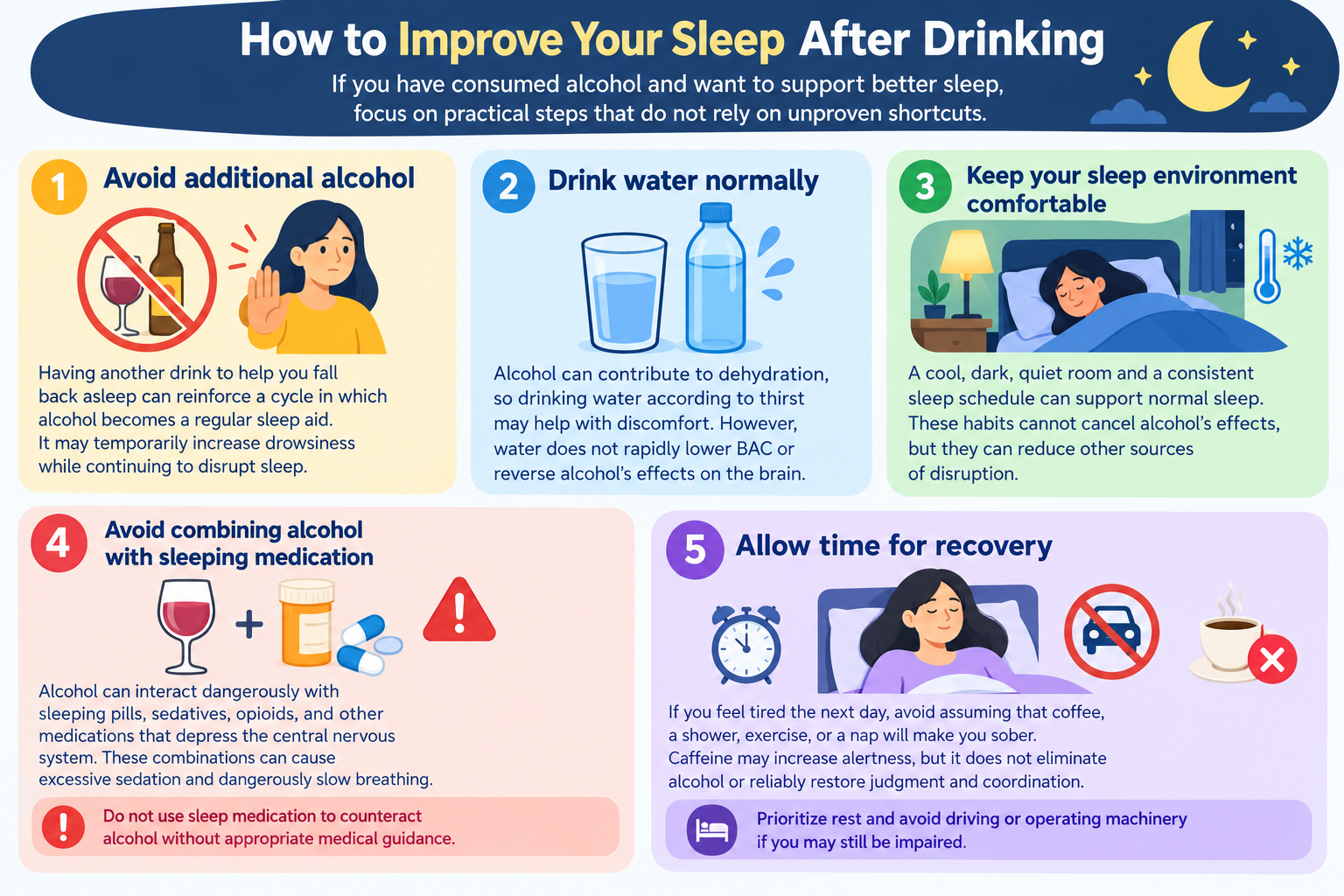
If you have consumed alcohol and want to support better sleep, focus on practical steps that do not rely on unproven shortcuts.
Avoid additional alcohol
Having another drink to help you fall back asleep can reinforce a cycle in which alcohol becomes a regular sleep aid. It may temporarily increase drowsiness while continuing to disrupt sleep.
Drink water normally
Alcohol can contribute to dehydration, so drinking water according to thirst may help with discomfort. However, water does not rapidly lower BAC or reverse alcohol’s effects on the brain.
Keep your sleep environment comfortable
A cool, dark, quiet room and a consistent sleep schedule can support normal sleep. These habits cannot cancel alcohol’s effects, but they can reduce other sources of disruption.
Avoid combining alcohol with sleeping medication
Alcohol can interact dangerously with sleeping pills, sedatives, opioids, and other medications that depress the central nervous system. These combinations can cause excessive sedation and dangerously slow breathing.
Do not use sleep medication to counteract alcohol without appropriate medical guidance.
Allow time for recovery
If you feel tired the next day, avoid assuming that coffee, a shower, exercise, or a nap will make you sober. Caffeine may increase alertness, but it does not eliminate alcohol or reliably restore judgment and coordination.
Prioritize rest and avoid driving or operating machinery if you may still be impaired.
Wrapping Up
Alcohol can make you feel drowsy without helping you sleep well. Its effects on the brain change throughout the night, potentially reducing REM sleep, increasing awakenings, and leaving you tired the following day.
Understanding BAC, alcohol metabolism, and the limitations of BAC calculators and charts can help explain why neither a drink count nor a legal BAC limit tells the whole story about sleep.
If better sleep is your goal, avoid using alcohol as a sleep aid, limit alcohol close to bedtime, and seek professional guidance if sleep difficulties persist.
